Showing posts with label complete streets. Show all posts

Tuesday, October 1, 2013

What Will Our Future Neighborhoods Look Like?

Like all cities, the suburbs are where most of us live and as a general rule we do not spend all of our time there. I can almost equate that with remaining inside your bedroom or man-cave when there are other parts of the house to explore and use. We entertain in the formal living room or dine in the the kitchen if it is informal and the dining room if it is not. Today's housing is a much more mixed blend of uses but our neighborhoods and suburbs are not. I, and others, believe that that may soon change.

I have lived outside of Man o' War for only two years. Those 2 years were over two decades ago and are still the dullest times of my life. Getting to work and anyplace remotely interesting to me was more effort than I usually want to put into something. Therefore, the idea of making Lexington's suburban neighborhoods more like their “first ring” older brothers and sisters is something on which I fixate. I am always looking for ways to help make that change happen.

Suburbs, or at least those which follow the American-style model, have been called obesogenic , that is inducing its inhabitants to become fat. Along the way, they have been called sterile, homogeneous, anti-social simply because they are auto-centric and, for the most part, very inefficient. Is there any hope for an urban form so maligned to transition into someplace more desirable? Some experts think so and I believe that they may be right.

Many places in the U.S. the suburbs are beginning to emulate the patterns of cosmopolitan city centers, becoming more dense, taking on new forms and practices and responding to economic and cultural changes in our world. I am looking for ways to get Lexington moving in such a direction. Maybe we can grow the city and protect the rural area in doing so.

Without a doubt, the ideas which develop in American suburbs end up influencing at least the affluent suburbs around the world. In a recent article in Planning Theory & Practice, Arthur C. Nelson and others discuss the demographic changes and shifting consumer preferences that are likely to have dramatic implications on suburban design in the next few decades.

Government subsidies, economic prosperity and demographic shifts since the end of World War II have led to generations of low density suburban growth which continue in Lexington to this day. Could it be that current economic conditions will begin to alter our development practices toward denser and better connected neighborhoods/communities. Will we see a re-commitment to urban and urbane living?

One place where w could begin that re-commitment is in our public investment and financing strategies to keep up with expectations for services such as public transit. Our regulations and development financing need to shift away from contemporary practices to support re-urbanization policies.

The process of “fracking” has led to the recent growth in petro-carbon production and the proposals to build pipelines from Canadian tar-sands to southern refineries may signal that “peak oil” has not yet arrived. But to assume that the return to the era of cheap energy may be sheer folly. We still need to shift away from the reliance on the private automobile. Despite consumer preference surveys which indicate that people say they would choose cosmopolitan options, those options need to in place before the choice can be made.

The suburban landscape needs to be able to transition in form, function, and pattern as quickly as community needs change. Financing practices, community attitudes and, above all, our zoning regulations currently restrict that transition flexibility. Zoning codes and covenants enforced by developers, neighborhood and homeowners’ associations have increasingly limited the potential for ready physical adaptation. 

How will we find ways to address the needs of the less affluent when the market producing our housing has other priorities? Jill L. Grant, Professor of Planning at Dalhousie University (Halifax, Nova Scotia, Canada), said it best “In trying to address the problems of homogeneity and inefficiency which we regret in our old suburbs, how can we avoid stimulating gentrification processes that suburbanize poverty and disadvantage?”
Nelson is Director of the Metropolitan Research Center, City & Metropolitan Planning at University of Utah so he probably understands the subject of urban sprawl as well as anyone. Having grown up in a suburb of Portland, Ore. and having to drive everywhere, I believe that he seen the beast that sprawl has become firsthand. He has also recognized the American suburbs are a unique development form that may be replicated in some fashion around the world although not to the extent that they are here at home.

American planners have built our suburbs as mostly low density, with uniformly developed landscapes of few land-use interactions and an intentional dependency on the automobile. At about 14,500 individuals per square mile, the suburbs of London, England are more densely settled than such central cities as Boston, Chicago, Los Angeles and Philadelphia. The actual City of London has under 10,000 residents of its own. It really becomes easy to see that we have planned the very urban vibrancy we seek out of our neighborhoods.

“Unlike suburbs in much of the rest of the world... ... American suburbs do not have mixed land uses or a range of housing options, and lack densities to support public transit.”

Nelson has identified three reasons as to why suburbs in America are different. 

First, Americans have an entrenched anti-urban sentiment with strong libertarian undercurrents to the point that an individuals property rights are above the community's interests. Outside of Lexington and a few other communities, few impediments exist to developing open land and that facilitates the low density environment which encourages sprawl.

Second, government (and financial institutional policies) since the Depression favor new construction over rehabilitation, new highways over public transit, construction of owner-occupied and detached homes over rented and attached homes and converting farmland/open space into low-density suburban development over sustaining working or passive landscapes.

Prior to World War II, the worries in housing were from urban pollution brought about by over-crowding and lack of sufficient daylight. After the war, the plans actively sought to reduce the residential densities for public health reasons. Section 701 of the 1954 Federal Housing Act provided grants for land-use planning templates which separated residential subdivisions from retail uses, employment centers and civic institutions. All of the things which make a neighborhood and community a vibrant and desirable place to live.

The third reason is a direct result of the preceding two. Subsidized road projects and subsidized energy costs helped to inflate the value of land for suburban development. More efficient development was economically punished while less efficient development was rewarded. More suburban uses imposed negative externalities on adjacent farmland which depressed the farm land's value and virtually assuring far more land was converted than would otherwise occur.

There is little doubt that suburban America will continue to dominate growth and settlement, but one should expect it to become more urban along the way. Recent preference surveys and projections of demographic trends hint that America’s suburban future may be quite different. Lexington has embarked on a path of infill and redevelopment which may need to achieve a certain level of neighborhood urbanity to work.
So, what are these emerging trends that Nelson has identified?

1 Rising energy costs

From World War II until the early '70s there was a vast supply of cheap gasoline and being able to drive out to the inexpensive land available for home building took home ownership rates from 55% in 1950 to 69% in 2004. Rising fuel prices may dampen the appeal of the suburban fringe for home buying, with or without self driving cars.

2 Lagging employment

The structure of the American labor force has made it prone to high unemployment as may be evidenced by the dismal recovery from the Great Recession. A key component of employment and income recovery is educational preparedness and in many cases America trails in many categories. A rapid population growth among those who are less prepared to succeed, could lead to lower wages and higher unemployment rates. Without falling home prices and and a return to the previous mortgage underwriting policies there may be lower home ownership rates in 2035 than in 2010.

3 Falling incomes

Median household incomes for ALL age groups in EACH income category ended the decade lower than in 2000. Suburbs have accounted for nearly half the increase in the population in poverty. Add this with trends 1 & 2 and the effects may further lower demand for owner-occupied homes over the next decades.

4 Shifting wealth

Nearly 99% of America’s wealth was held by the highest fifth of households. Well higher than most of the last century. The shifting of wealth in the US means that America has become a nation where wealth inequality is greater than in many emerging countries. It is now more difficult to rise above poverty than in nearly any developed country.

5 Tighter home financing

In the wake of our recent financial disaster, lending institutions have increased their underwriting requirements, thereby reducing the number of people who can buy a home. Conventional mortgages now need higher credit scores, longer and more stable work histories, and 20% down payments. Those changes alone may disqualify about five million potential home buyers, resulting in 250,000 fewer home sales and 50,000 fewer new homes built per year. 

6 Changing housing and community preferences

Americans are looking for something different in their homes, neighborhoods and communities than they have had in the past.

The latest period of suburbanization, what we generally call the “era of sprawl” began in 1948 and is basically a “parasitic” version of suburbanization since it fed of off resources not generated by the growth itself. Fiscal policies, both State and Federal, transferred wealth from cities to suburbs though subsidization of roads and energy. Taxes on existing infrastructure and property allowed for reduced levies on developing land. Land-use and zoning codes socially engineered many a community composition. 

The bursting of the “housing bubble” and, for Lexington, the EPA consent decree are some evidence of the price which has now come due.

Robert Fishman, as an Associate Editor of the Journal of the American Planning Association, has suggested a fifth migration emerged during the 2000s. Since 2005, we have seen a re-urbanization of the inner city and our older suburban areas. It has been led by the young professionals, many an empty-nester senior, and and even immigrants. 

It is exactly the disadvantages of our inner-city districts, the “obsolete” retail and manufacturing facilities (Bread Box, Distillery District, et. al.), the pedestrian scale, an ability to rely on mass transit and even the aging housing stock which are being turned into advantages in this fifth migration. I think that we may need to extend or replicate some, if not all, of these new “advantages”into the suburbs once held by the “fourth migration”. That area we now call sprawl.

The challenge in making this transition is to change attitudes of suburbanites. This is a tall order. Nelson suggests that “local governments will need to become proactive in applying affordable housing tools such as density bonuses, subsidized low and moderate income housing, and inclusionary zoning.”

Older and closer-in suburbs, those built at low densities, may find retrofitting them a bit difficult but higher density redevelopment can be accomplished by using parking lots and low rise, low intensity nonresidential property along commercial corridors. Neighborhood opposition and disagreements along these commercial corridors pass may undermine any opportunity of transition.

As Nelson ends his piece “Successful American suburbs of the future will be resettled by very different kinds of households.” I ask, when will we see it here?

Tuesday, September 10, 2013

A Look At The New Comprehensive Plan - Part 2

Continuing the look at the 2013 Comprehensive Plan.  Today we will look at some of the tools being considered.

The concept of Complete Streets has found a home among the Planning staff if not in the hearts and minds of most neighborhood residents. The Complete Streets program encourages our city streets to become what they have been for centuries – except this last one – a place for all of our residents to use for getting around town. A good design can reduce auto trips by allowing access by foot or other means. That same good design also means that there is someplace of necessity/desire within a reasonable traveling distance, otherwise the usefulness declines.

Complete Streets should not be solely about including transportation and beautification amenities. They need to include convenient neighborhood destinations which allow residents with one another in ways beyond a wave as they speed to work or collect the mail from the street side box. Walking to a corner diner or tavern bound many a neighborhood together that few understand today.

The Plan does speak to the issue of traffic speed and pedestrian safety. “Traffic speeds dramatically affect a pedestrian’s actual and perceived sense of safety...” only states one side of the equation. Pedestrian activity and resident attention can also dramatically influence the care that motorists need to exhibit for safe operation of their vehicle. Many neighborhoods have abdicated their streets to the motoring public since they need their cars to anywhere themselves. If you want to create a successful neighborhood, create a series of places for the residents to go and a way for them to get there safely.

Successful neighborhoods can have a variety of housing types.

Take Ashland Park as an example. For years the typical image of Ashland Park was of a single family subdivision built from the early 20th century but the area is riddled with duplexes, apartments and mother-in-law suites. They are all hiding in plain sight and designed so as to not call attention to their different purposes. Driving by, one would be hard pressed to tell the difference until you get to the sections built after the '30s.

Why do today's apartments have to look so different from any other housing style? By the same token, why do renters seem to care so little about their dwelling place be it an apartment or a house? Is a walkable, connecting focal point someplace where renters can blend with the neighborhood? Today's method of relegating apartments to the massive complexes on the major corridors removes valuable intra-neighborhood cohesiveness as well as diluting what could be a vibrant focal point or two.

The Plan text is not wrong when it says,
These neighborhoods will have a clear sense of place when the following standards are met:
Inviting streetscape
Varied housing choice
Abundant private and public open space
Neighborhood focal points
Quality connections with parks, schools, and stores
The question is- How do we strengthen the fabric by reweaving from the existing thread rather than trimming back to apply a possibly ill fitting or mismatched patch?

With that in mind, take a look at what the Plan says about the focal points of a neighborhood.
Neighborhood Focal Points
The character of a neighborhood is made of more than a collection of bricks and shingles. Character encompasses a broad array of qualities. A focal point can be a gathering point such as a park, a shopping center, a community center, or public square. To the extent possible, new residential development should be developed to accommodate future sites by allowing for easy integration into the neighborhood and allowing for easy, multimodal access from the neighborhood instead of development that turns its back on a community center.
The last sentence, again, is written from the perspective of whole new developments, but the thoughts expressed in the first part apply full well to aiding in the strengthening of existing neighborhoods.

I have only come to realize lately (and it may have been the Kroger zone change) that stores in the shopping centers on corridors may wish to engage the neighborhood, but turn their dirtier side to those they wish to engage. By catering to the auto-bound shopper, they have lumped all of their customers in a single, lone category. I wish that I knew how to begin reversing the situation.

Small area planning

The use of small area plans has been around since the 1973 Plan even though planning areas have existed from the 1963 version. The '63 areas were divisions of the urban area and split by the city limits boundary which made planning for logical unit quite difficult. The 1973 plan, being post merger, allowed greater continuity in looking at whole neighborhoods under one legislative jurisdiction. Most of the small areas planned then were for developing subdivisions and leaving many a transition of uses to go uncontrolled.

Small area planning is now going to be applied to strengthening our declining or transitional neighborhoods to bring about neighborhood stabilization and revitalization rather than guiding growth and development. Surely there must be growth of some sort to make some of these areas desirable.
Desirable communities in Lexington possess a number of characteristics, including access to transportation, jobs, and quality food.
The above statement about desirable areas is basically true but the access described is mostly resident provided and areas which lack it fall into the candidacy for an area plan.

I think that it should be noted that three of the recommended areas for small area plans were developed between the planning areas of the '63 Plan and the SAP's of the '73 Plan. That could indicate a failure to do better implementation of those plans.

Development Incentives

There is included in this draft text some development incentives which, currently not adopted or in force, could allow great neighborhoods to be built (or rebuilt) where we now see just subdivisions.
Review the zoning ordinance for impediments to the development of successful neighborhoods with an eye towards retooling zoning categories that are not fulfilling their potential.
This could go a long way toward allowing and encouraging the natural development of neighborhood local focal points, which in turn can create more walkable communities.
Establish an objective and standardized process to evaluate new developments for neighborhood character that, if met, would expedite approval of the development.
While not saying so, I expect that NOT meeting such a standardized character criteria will delay or prevent any approval of projects. This is not out of line with my thinking on CentrePointe since there is no established standardized process, now or 5 years ago.
Enable the Division of Planning staff to approve final record plats.
This, when used in concert with the above, will remove the Planning Commission from considering where the property line will go and may shorten the time necessary to implement approved plans. It should also be used to prohibit a lot pattern which does not assure true connectivity or density.
Convene a summit of financial and neighborhood development leaders in order to increase understanding of the financial costs and challenges to funding mixed-use, multi-family, and innovative developments.
Ensure that exaction fees are reviewed and revised to meet the infrastructure needs of the Expansion Area.
Establish partnership opportunities by funding the Land Bank and creating an affordable housing trust fund.
Pursue Federal and state funding for high-cost projects of a community interest, such as bridges and community centers.
Next, we will look at the environmental concerns

Monday, April 22, 2013

Whither A State Of Transportation?

Sometimes it is quite difficult to determine on what subject I want to write and at other times the subject just leaps at me. Lately I have been reading about the transportation situation facing us locally and nationally and how we will pay for it.

With all of the construction workers out of work will a resumption of the highway building and other major building projects help solve the unemployment problem? Will spending more money on highways prove sensible while Americans are driving less and the younger generation is buying fewer automobiles?

Back at the end of March, the architecture critic for the Philadelphia Inquirer Inga Saffron, posited that perhaps we American's are a bit too haphazard about how we allocate our transportation funds. We tend to push for lane and intersection improvements to some of our arterial streets in Lexington, huge Interstate interchanges in downtown Louisville, and massive new bridge projects in Cincinnati and Louisville. But, when it comes to any sort of mass transit style proposal the masses go all livid about the freedoms of movement and choice which will be infringed.

Highway funding is becoming increasingly tight, in part because Congress and States are unwilling to raise the gasoline tax on steadily rising fuel prices. The American Society of Civil Engineers believe that we are so far behind on infrastructure repairs that they recently gave an overall D+ to the conditions of our nation's bridges and roads. One must realize that it is in the best interest of the ASCE to chase new construction projects for their members. I personally feel that this grade is not from design and age, but from simple overuse of a “free”amenity.

Around the same time, a writer for the Washington Post revealed that the famous Capital Beltway was slowly dying beneath the turning wheels of about a quarter-million cars a day. As they called it, “turning to mush”before their eyes. In what sounds like an excerpt from one of our Council work sessions, “... the older base layers under the asphalt, the surface is not able to absorb the pounding the way it used to...” was used to describe the continuing situation.

I don't believe that the Beltway or any of our primary arterial roadways will die, but they will need to be relieved of much of the stress to which we put them. U.S. drivers, and the commerce on which they rely, are riding on baby-boom-generation roadways, which like us boomers ourselves are no longer so steady and sound. Nearly a third of the nation’s major roads currently need significant repair or replacement, with a far higher percentage in the busiest urban areas, to meet the demand now placed on them.

Bad roads are partly a cause of sticker creep at the checkout aisle, just as the the cost of fixing them is about to cause sticker shock at the gas pump. Delays and bad roads add to the $25 billion in goods delivered nationwide every day which is naturally added to price tags at supermarkets and department stores.

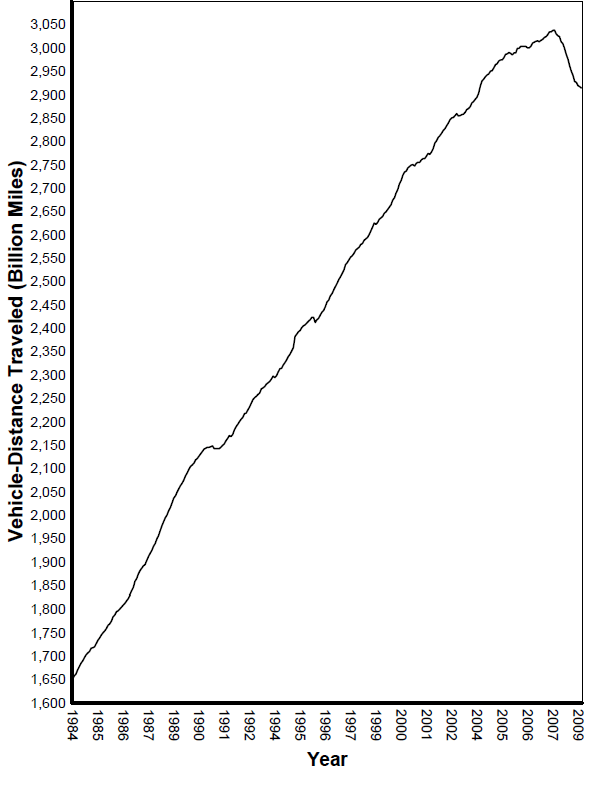
Many state's officials see roads that need replacement and highways that need to be expanded. They cite statistics which show vehicle travel jumped by 39 percent from 1990 to 2008. Despite an acknowledged decline in vehicle miles traveled over the past 5 years, the forecast is to increase another 35 percent by 2030. 

Add to all of the above the comments I heard at the forum on climate change held last week at the University of Kentucky. 

In his presentation on looking for “Free-Enterprise Approaches to Energy Security and Climate Change.”, Bob Inglis, former U.S. representative from South Carolina, expressed his thoughts that sometime, in the near future, we will be traveling the highways in packs of high-speed, robot driven and individually powered vehicles.

According to one description that I have read, this would be a whole new world of cars are packed nose to tail traveling at speeds in excess of current limits. They will weave their way through unmarked junctions, with no traffic lights. Lane markings are non-existent, and stretches of road may switch from being one-way in one direction, to the opposite, with no warning. Perhaps most alarming of all, very few of the “occupants” have even passed a driving test. I see more similarities of riding high speed rail in this than shopping for the family car.

This sounds like Utopia if it occurs out on the open highway lie an Interstate, but do we want this in our urban areas and residential streets? Just when we have made good gains in taking back the streets (Complete Streets planning) from the free-wheeling autos, will we have to redouble our efforts again?

From my personal experience of Interstate driving, I am either passing the casual drivers and the revenue generating long-haul truckers or being passed by, largely singly occupied, long distance commuters, but the common theme is that, unless it is rush hour, we all have plenty of room. 

Efficiency and logic should dictate that these packs of robotic driven vehicles be composed of like vehicles. Trucks with trucks, SUVs with SUVs, single occupants with single occupants on down the line. Also considered should be the fuel and maintenance compatibilities of those allowed in each pack. Sounds like it may be simpler to take the train.

Such vehicles may be much more aware of their own positions and of those vehicles around them, but they also need to be aware of all other animate objects before they are allowed to roam our residential streets. I would worry less about the auto leaving the street than I would about the random child/toy or the stray pet/wild animal entering the roadway.

But, let us assume that all of these possibilities are accounted for and that there will be NO accidents (Yeah, I laughed at that also). If there are no accidents, then there is no one at fault and there is no need for insurance. Norm McDonald, Flo and that Allstate guy will have to join the gecko in the audition line for work. Darryl the “Heavy Hitter” and all of those other law firms will have to fight over the remaining legal claims.

Making further assumptions, I see all of the auto dealers trying to differentiate their models from the other mundane “hop in and let the robot have all of the fun” vehicles out there. There will be no “thrill of the open road” if all are running in packs and we are watching the scenery flying by. The “sports car handling” so familiar to the earliest baby boomers and lacking on most all SUVs and trucks will not be a selling feature unless you are buying antiques.

I worry that the free enterprise of this will inflate the ranks of the unemployed while not solving the infrastructure cost dilemma. Young people are driving less, automobiles are costing more (both initially and over their lifetimes) and the real-time level of wages is stagnant so who will be able to afford such extravagances? And will the roads be there upon which to use them?

Saturday, November 7, 2009

Gridlock And What To Do About It

Our favorite transportation planner, Randal O'Toole has a new book coming out soon called "Gridlock: Why We Are Stuck In Traffic and What To Do About It". This book is supposed to set the planning world on its ear.

The ideas put forth here are the same that we have heard from Mr. O'Toole for years. That American people cherish their mobility and that the personal auto is the ultimate in convenience. Not only is it inexpensive but it is available to nearly any family in the developed world. That mass transportation(buses, trains etc.) are not a replacement for the personal auto and limiting auto mobility would be detrimental to society. I wonder what the good people of New Orleans will say when they remember the post Katrina days of no transportation out, even when there were plenty of buses with no drivers.

O'Toole says that this book will oppose any government subsidies to any transportation mode as well as any government efforts to reduce individual driving. Any subsidies? Does that mean funds in addition to the Highway Trust Fund which cannot cover all that is expected of it now? Lexington and the state of Kentucky cannot currently maintain the road that they have sufficiently, much less any new or upgraded roads.
Users should be able to choose whatever transportation they like as long as they pay their way.

The Antiplanner, from The Ultimate Transportation Antiplanning Book

As a resident of Lexington and a driver in the state of Kentucky, I do not see my personal local money being used to repair any street or any parking lot. Those funds come from the hidden increase in the cost of goods and services that I buy, and not just the frivolous stuff, I am talking about the basics of life. Anything that moves over the roads is subject to the fees and the additional cost is passed on to the consumer. The cost of maintaining the parking lot at the local grocery is added to the price of food, the lot at the movies is added to the price of the tickets and the road in front of my house is added to the property tax bill(given the residential density of our suburban sprawl, most streets will not pay for themselves).

O'Toole also tries to get away from the old argument of rails vs. roads by pushing a new third position, using technology to provide mobility and congestion relief, by making the current roads more efficient. Using driverless vehicles. Driverless cars that will allow more vehicles to move closer to each other and at higher speeds and hopefully with no collisions.

This, of course, would require the rebuilding of all the roadways with the technology capable of controlling such vehicles AND the requiring the retrofitting of autos with these controls. I imagine that this would be paid for by the auto's owner and the owner of the roads. Currently the government owns the roads and since they(the government) are not allowed to subsidize the system, the government may not upgrade the roads, so I wonder who will. There is also, at this time, a strong opposition the the installation of GPS tracking devices for the recording of VMT on which to base a roadway fee(tax) in lieu of the gas tax, so will total control be allowed by the general driving public? Anyone with the OnStar system already has the GPS tracking so it may not be a problem.

I am curious to know which roads will be the first to be fitted for the driverless controls. Will it be the Interstates and the major US highways between our major cities( the one that flow fairly well as it is) or will it be the urban arterial and collector type streets where the commuter back-ups occur today? How far down the functional classification list will the control level go? Will it extend to the local and cul-de-sac level, if not how will you get your auto to the closest control point? Will manual control and driverless control be able to mix on the roadways? And what will become of the "complete streets" movement that seems to be sweeping the country these days.

Thinking about this brings to mind an online conversation I had with another commenter to a Herald-Leader article. A resident of Richmond, Ky. had expressed his opinion on spending money on some changes to Esplanade. His premise was to spend more money on widening the streets of Lexington, to allow his daily trip through town(from Richmond to Lawrenceburg) in a 4x4 truck to be made in a less obtrusive manner. He wants us to spend our funds to make his commute better and he does not live or pay taxes here.

I, of course, took offense to his callous abuse of Lexington's already horrendous carbon footprint and suggested that we(Lexington) did not need his type mucking up our county. It soon became evident that this Madison County redneckwas not the type to be told that he would(or could) give up control of his vehicle. Clearly his actions to get ahead were ones that have been taught and will, if followed, place one squarely behind the eight ball in the coming environmental and financial paradigm reset.

Randal O'Toole and this fellow from Richmond will both resist the government's intrusion to their lives, but I doubt that they will agree on Lexington's traffic problems.

Monday, August 24, 2009

Thoughts On Some Current Controversies

Several things have come to mind today that relate to some current events.

There has been a great controversy about the overhead wires either being shown(or not) in the pretty renderings of the Newtown Pike Extension. Several people have their shorts in a wad about the subject and compare a simple set of poles and wires along the new roadway to the gigantic transmission lines being placed on Euclid and Woodland. I personally have a greater disdain for the wide right of way and lack of urban businesses facing this new "urban" thoroughfare. The setbacks for any buildings along here are NOT what an urban roadway should be.

The mistakes being made on this road are the same that were made with the widening of Vine St forty years ago. Wide travel lanes, buildings set away from the street, facilities for pedestrians, but no reason for them to be there and the traffic lights timed to quickly get the autos past the things that they are not interested in. In other words, a raceway from the Interstate to UK (and I do believe that UK will begin expanding the campus to the west in the near future).

One mistake that they are making anew is the omission of the possibility of a fixed guideway transit mode, and I do mean a streetcar line. From UK to the BCTC campus, then over to Transy and on through downtown to UK again. In any case, with or without a streetcar facility, I don't feel that this project ends in a "complete street" in any sense of the concept.

The placement of the utility line overhead is said to ruin the aesthetics of the road and will ruin the streetscape. A fellow blogger, who is a transit consultant, is currently in Vienna and reports that to the Europeans the overhead wires are just part of the charm. I shall simply state that due to all the other errors in the design, the wires overhead is the least offensive.

On another note, that of growing our food locally and very close to home, I came across this bit of information from Seattle.

The Seattle City Council has relaxed its rules about requiring a permit to place anything in the parking strip. The parking strip is what we call a utility strip, that area of grass between the sidewalk and the curb. They now no longer prohibit growing food in the parking strip and many Seattlelites are jumping at the chance.

Lexington's usual utility strips are a bit narrow for something like this, most are only 5 1/2 feet wide, with the wider ones in the more affluent neighborhoods or along the newer boulevards. It also appears the Seattle does not have a street tree requirement and they are the more sunny area of the front yard. One of the photos in the linked article shows a few rows of corn growing in the strip and right at an intersection. I wonder how they keep that sight triangle clear. Low vegetables in raised beds are one thing but the more vertical or climbing stuff must be a problem.

Not only is Seattle using the streets, but portions of the city parks and creating local farmers markets in neighborhoods, thereby not only growing it locally but selling and eating it locally. I have seen, on two occasions, the kitchen staff of Natasha's walk out to the herbs that they had growing in the street tree planter bed, and cut some of the fresh stuff for the dishes being cooked. You can't get any fresher than that.

Sunday, August 23, 2009

What Is Happening On Two Way Streets

Today's question is about the impending change of the one-way streets in downtown to two-way streets. There has been much said about it in the press this spring, at least to a point, then nothing. They say it has to do with the "complete streets" concept yet beyond the streetscape project currently in progress very little has been publicized.

I am aware of several meetings of a "working committee" about the first pair of one-ways to be considered, Second St and Short St. There have been visual inventories made with aerial photos and a video taken along the two streets and lots of notes. I also hope that there have been discussions with more than a few of the affected businesses and property owners.

I think that we all have heard the fall out from the South Limestone corridor owners and their claims(valid or not) of a lack of timely notice, understanding of the total concept or awareness of the late changes in the scope of work. If there is any way that these problems could be avoided in this venture, can we make sure that we do it RIGHT this time?

I read from the comments on a post on UrbanCincy, that some Cincinnati council members are also considering the elimination of some of their one-ways, and Charlotte, NC. has already started.

The controversy in Charlotte also appears to be very similar to Lexington, in that they have a number of one-ways like Vine St. No storefronts or places for pedestrians to pause for, and certainly no reason for the autos to slow down for. The wide roadway and timed lights make for a quick way to get through town but absolutely no reason to stop in town. Vine St is not a destination(Main St is little better) so it is no wonderthat during the '70s and '80s some people thought of proposing to bridge it when considering the redevelopment of some of the downtown blocks, a la the Galleria proposal.

It seems like such a simple thing to do, just make one of the lanes flow in the opposite direction, but after many decades of living with the traffic flow as it is it could be a traumatic situation for some. Some of these streets have been one-way for better than 70 years, but changing them to two-way may set the course for the next seventy.

For now, I just want to know what the progress is.

Monday, June 15, 2009

A Transportation Gap?

We have all read the stories about the recent implosion of the American auto industry and the notices that were sent out to the various auto dealerships across the country. Between GM and Chrysler the total come to over 3,000. Who among us did not see this coming?

The competition between brand and models lately has become more of a difference of rebates and financing than quality and function. The autos offered provided less mechanical innovation and more size and flash and the dealers convinced the buyers that that was what they wanted. Very much the way that home builders built only a few basic styles and told everyone that they were the ones that were selling. Even when the hybrid autos (and highly efficient houses) appeared there were so few and they cost a premium price that the sales numbers could not match to usual models. Thanks to those who held out and waited for them (and higher fuel prices) the offerings of the automakers (and homebuilders) are beginning to change.

The local headlines of the past few weeks have declared that only a handful of Kentucky's dealers have received notice of their contracts ending, but have we only seen the first wave? According to the FHWA the vehicle miles driven in the US has fallen for almost a full year now, but strangely the total miles driven in Kentucky are on the rise. This may be the result of having to travel farther for employment in the more rural eastern portions of the state or the sprawling of the suburban areas of the population centers, but this will change as the price of fuel rises again. I doubt that we have seen the end of dealer closings.

In conjunction with the vehicle miles driven reduction is the loss of revenue for the Highway Trust Fund which pays for the government's portion (80%) of new highway jobs. I also feel that the balance in Congress will affect the way Kentucky will benefit in the future. The Democrats in power may try to coerce Mitch McConnell to compromise by withholding highway money and projects for our state and local jobs.

Today, I also read the American's are flying fewer miles for the thirteenth month in a row for both business and vacation travel. Here the decline is even greater than in auto miles in a year to year comparison. This may have an adverse affect on the Alltech WEG in 2010, and for that we have no contingency plans.

It may already be too late for Lexington and Kentucky to prevent some kind of transpotation gap from occuring in the near future. We have not planned for any structured mass transit(i.e. light rail, streetcars) nor have planned for greatly walkable cities and complete streets. We will also need to plan for the delivery of goods and freight by some other means than truck, if fuel prices get too high, as well as growing more foods locally.

What are you doing to close your transportation gap?