Showing posts with label streetcars. Show all posts

Sunday, July 14, 2013

Are We Planning For Real Change

Apparently seeing one of Google’s experimental, driverless cars driving or parking itself on a San Francisco street, is not all that unusual. So, can you imagine just how the widespread use of driverless autos might affect the city of Lexington? Would you be much different than the residents here in the late 1890s had they been told that horses could soon be a rare sight in city streets? How will you react when you first encounter an example of one?

With so many people working and thinking about this technology will our planners soon have to begin incorporating provisions for it? Most of our city's plans have been prepared as looking about 20 years into the future, yet history (our history) shows that our future is moving well faster than we have ever planned for. My favorite example is the plans to expand our former streetcar system in 1930 and within the decade the whole system was gone. Life moves a bit faster these days.

A common scenario for driverless cars is one where you don’t drive in circles looking for a parking spot because your car drops you off and then parks itself to await your call. From a current local viewpoint this is desirable since it is your car and you want it available when you need it. From the view of one from a more populous area, a taxi or car service can work better, hence the rise of Zipcar and Uber. 

For many in this country, an automobile is a mobile storage devise for their belongings and which takes them places.

Next, let us imagine that we will eschew the use of “personal” autos for the ease of use of driverless car services. The then common dream is that surface parking lots will become park or recreation areas. I find wildly unlikely unless it is a city owned lot and most are not. Parks are a revenue drain and not a revenue generator, therefore the bane of private investors. 

What do you expect to see happen to this property then? Can you squeeze a modern usage building on some of these oddly shaped lots without taking a few “historic” structures?

Shifting our attention to the streets themselves, many say that we will need far fewer traffic signals when both autos and the streets are equipped with sensors and can coordinate between each other. What does that do to the walkability of an area? Can we cross the street safely with out traffic signals if the driverless cars are zipping by nose to tail with each other?

On the one hand, streets can then be narrower if there is no need for on street parking, but narrower streets are a problem to some of our massive delivery vehicles. Until they develop a self unloading delivery vehicle I doubt that we will see a driverless one. Parking lane may disappear but the loading zone will be with us a while longer.

In our suburbs we can begin to eliminate the large expanses of parking at the shopping malls and big-box stores if the trips are made in neighborhood “pool car” which will drop you off and come to get you. (Kind of sounds like a circulatory bus without a driver doesn't it?) To what use will all of that land be put then?
May we also see the loss of the attached multi-car garages with their mostly blank panels or, worse yet, a gaping maw of an opening. Among many Millennials the auto as a status symbol is a foreign concept and it is becoming harder to sell them on it.

Speaking of selling things, how will they sell driverless car and to whom. 

It's no secret that car commercials are, by and large, fiction. Shiny cars roaring along empty city streets devoid of traffic jams. Not a traffic jam (or signal) in sight, just the joy of the open road for the driver. How can you get an exhilarating feeling if you are not driving? Will car commercials disappear like the cigarette one did but for different reasons?

How soon do you think that some kind of drastic change can come about? Above are just a few of the early changes that we could see should we adopt the driverless auto as quickly as we did the “horseless carriage”. Perhaps you have thought of something I left out. Drop me a line and tell me you thoughts.

Friday, November 23, 2012

Like Things Of The Past

In the past several years the leaders of our community have brought in, sometimes at great expense, recognized experts to assist in our downtown planning. Folks like Jeanne Gang, Omar Blaik and Gary Bates have contributed their talents to specific projects and usually, very limited parts of our collective home, Lexington Ky.

Each time great care was taken to collect detailed physical data and a distilled compilation of opinions from the “stakeholders” of the project de jour. The results of these “expert” visits are then revealed with much ballyhoo and flair, which is then followed by the common nit-picking and nay-saying of the newspaper commentators, the search for political will and the greater funding with which to pull it off. Our success rate in the last decade is less than spectacular and maybe even abysmal. Certainly the rate for the last several decades is shameful.

Maybe the downfall for these expert plans was the consistent, limited scope of the individual project or the often trendiness of the solution which, as all trends do, fell quickly out of favor. Some of the trendy plans were misapplied and failed, even before the fad could run its course.

One sure element which has been left out of nearly all of these “solutions” is the need for the “human scale” elements, that's us humans, to interact between the various loci without mechanical intervention. In other words can we walk safely, comfortably and quickly from place to place and without feeling like we were wandering the Sahara. Traversing a treeless stretch of sidewalk or parking lot, either in the summer or winter, is no fun with or without a bunch of kids in tow.

I am currently read the new book, Walkable City - How downtown can save America, one step at a time by Jeff Speck, and though I could try and blast through it, I am taking the time to really compare how Lexington stacks up to his suggestions. So far, our city is in dire need of his thoughtful suggestions.

Speck claims that we “know” how to build successful walkable cities. Or we used to, because there are very walkable, older areas in many cities which are the remains of how it used to be done. I seems that we just “forgot” the process some 70 years ago and for four decades we went about doing something different. Those four decades were enough to allow many folks to believe that “this is how we have always done it” and “it shouldn't be done any other way”.

Not being a math whiz, I can still figure out that 70 years or so ago was in the later half of the 1930s. Just about the time that we let the streetcar system in Lexington die and the automobile culture really take over. It was also about ten years after a noted “expert” was brought in to write and give direction to The 1930 Comprehensive Plan. The end of the Great Depression, assisted by the Second World War, brought many “progressive” ideas on modern life and we began to forget how to build walkable elements into our lives.

Some 25 or 30 years ago, some planners began to notice that the human element was being left out of the new buildings being designed for our downtowns and other civic areas, while others noticed it missing from our subdivisions and suburban shopping centers also. The problem was that they were going up against the previous 40 years of growing, conventional “wisdom.”

That 40 years of conventional “wisdom” is alive right here in Lexington as evidenced by the continued use of bloated parking requirements, great swaths of residential development on barely navigable cul-de-sacs and large retail developments which lack any type of walkability. Even though changes are becoming evident in public thoughts and actions (housing choices and driving patterns), the plan updates show no real changes in land use designations or transportation choices. In most cases, I feel that we are operating under the land use and development codes of the 1960s, albeit with some nuanced tweaks and adjustments along the way.

In some minds, we really do need to make our city walkable - but that just means doing some enhancements to the downtown area or making sure that sidewalks are included in all new subdivisions. Downtown is the major focus whereas the whole city should be the target and for those intoxicated by the kool-aid of conventional “wisdom” the downtown is a wasteland and more or better sidewalks are not the answer.

It is my belief that our local planers, though raised on the conventional wisdom model, do desire to institute real change. They have all heard and read about the re-awakening of urbanism as a development model but as long as the property owners and their developers are still meeting the calcified standards of old, then what we have will be what we continue to receive.

So the question now stands, how do we bring about the change necessary in Lexington? Will we get to a point that the conventional “wisdom” begins to cost us in terms of attraction and retention of the talent displayed by the “creative class” Millennials so desired by our city. Some already believe that the brain drain is in progress, but I have heard that for most of my adult life. Will the change come from our leaders or from the residents as they relocate to desirable areas – here or elsewhere? Also, how will the use of conventional “wisdom” impede the change so needed?

The latest edition of Business Lexington details the recent addition of two planning professionals who are looking for the change that Lexington needs to make. Dr. Derek Paulsen and Jeff Fugate may be just the people who can debunk some of that conventional “wisdom” but old habits run very deep. We may need to look to our past for some solutions.

In the past we have brought in “experts” and sometimes we listened, is it time for another?

With my ear to the ground, till next time.

Monday, January 31, 2011

Growing Old In Lexington?

I grew up in one of Lexington’s streetcar suburbs. The old mule cars ended a route just two blocks(and a hundred years) from my front door and in their heyday the streetcars went down the middle of my street. Progress marches on and the tracks were rerouted a little farther out in the expanding subdivisions but they were never more than a block from the house. Sadly, I came along 12 years after they ended their run and I never saw them.

Many of my neighbors did see and used them to get from home to downtown and some of the other destinations at which they stopped. It was one if the reasons that they bought in the area. Houses close to shopping, entertainment and recreation. It was also a neighborhood where folks could grow old and still easily get the necessities of life. With the streetcar they could get downtown to major shopping or they could walk to the local market or pharmacy, get their hair cut or meet friends at the local eatery. It was a neighborhood designed for multiple generations to live together, a real social network.

As a young fellow, I knew all of the families on both sides of the street and the people on the other side of the block. I knew where the kids(what few there were) lived and which of the houses were home to the sweet old ladies. I watched as couples aged, the husbands retired, the widows followed their spouses and the houses sold to others or became rentals. Even lost friends as their parents moved to the suburbs, but that was the way of the world in those days.

My next-door neighbor was a retired high school teacher whose eyesight was failing her. She had taught at the high school just a half a block from our house. She rented out a room to another lady who helped care for her, but we all kept an eye on her. As I recall, she lived there until about 6 weeks of her death.

On the other side, on the corner, was a retired doctor and his socialite wife. He was friendly to us kids but she never took time to talk to us, unless it was to shoo us away from her husband while he was working in the yard. The drove their late model Cadillac to Florida every winter and back in the spring, till that one year of the accident on the way back. Their estate sold the house for apartments soon after.

These stories are repeated, house by house, as you go around the block. The retired State highway engineer (where I saw my first old drafting equipment), the retired antique dealer, the retired preacher, and so on and so on. These people bought in this neighborhood, not as an investment but, as a place to live and grow old. These folks bought for the long term.

These are also not the type of subdivisions which have been built in the past 60 years. Today’s suburbs are built for the automobile. Nothing is really as close as a few blocks, especially when those blocks feature many cul-de-sacs and winding roadways. A 5 minute walk to the store is not the same as a 5 minute auto trip when you’re up in years, just ask the lady who drove into the grocery on Romany Road a while back.

The reality of today’s suburban living is, that it is for the children of the “Baby Boomers”. Children who chose not to live like their parents, in modest sized cottages, just like their parents who chose not to live in the old Victorians I the old town sections. Status usually led us to want more land and a bigger house, which now is more than most of aging population can take care of. Then there is the mobility, the constant mobility, moving for job, for family, for downsizing. Retire to where the grandkids are, except the aren’t in just one place, they are all over the country. My grandparents houses were stable, all through my younger years. So was my parents place, right up until my dad died and my brother and I took it over. Forty-five years in one place, just like it was designed for.

These are the types of residential subdivisions we need to see more of, don’t you think?

Monday, November 1, 2010

Things That Maybe We Should Be Doing

There are some things that we should be planning for, especially during this mayoral election cycle, rather that bickering about who has or has not done enough in the past four years. We should be talking about looking to the future in concrete terms, not just rosy sounding platitudes.

This past weekend, the state of Indiana and Progress Rail Services Corp. announced the intention to reopen a long closed industrial plant in Muncie, Ind. Progress Rail Services Corp. is a wholly owned subsidiary of Caterpillar Inc., a U.S. heavy equipment maker that has been moving aggressively into the rail business lately.

Why is this important to Lexington and Central Kentucky? Well, for one, it displays a coming revitalization of American industry. Something that our region desperately needs.

Caterpillar has long been known for their bright yellow construction and mining equipment, but recently they have been looking to get more into the railroad business. To that end, Caterpillar purchased Progress Rail Services in 2006 to repair and rebuild locomotives and freight cars for Class Is, passenger railroads and private owners. Although started in 1983, one reason that we may never have heard of them, is that much of their business is in other countries. They have more than 130 facilities and most are overseas. The Muncie plant will be largest project tackled by Alabama-based Progress Rail.

The situation took a sharp turn back in August when, due to an advantageous position of the autos bail-out, Progress Rail bought Electro-Motive Diesel Inc. (EMD) from General Motors Inc. Funding for the $820 million purchase came from the private equity firms Berkshire Partners LLC and Greenbriar Equity Group LLC. I see no direct connection between Berkshire Partners and Warren Buffet’s Berkshire Hathaway Inc. other than they both see American railroads and their attendant corporations as good business investments.

Although EMD's headquarters, engineering facilities and parts-manufacturing operations are located in LaGrange, Illinois, just west of Chicago, they do all final assembly in London, Ontario CANADA. So much for a “buy American” plan for our American railroads. EMD has also languished a distant second to GE in the American locomotive industry. This new plant will give Progress Rail locally produced locomotives to comply with the “buy American” requirements of publicly-funded passenger rail contracts.

Reports have it that this 740,000 square-foot facility and its 75 acre property will have a test track and allow the company to pursue transit-rail business. The site originally was home to a Westinghouse transformer factory and will require minimal redevelopment as it has rail lines built-in and rail access.

Transit/rail, would that be the streetcar or regional light rail that we see spoken of by the Obama administration and so easily dismissed by the Republican leadership of Congress? Will these 650 new jobs, which should come on line sometime in 2012 or later, be ascribed to the recovery efforts of Democrats or the Republicans? Will these 650 employees and their resultant boost to the local economy be a legacy of the “disastrous auto bail-out”?

When will Lexington seek out these types of developments? When will Central Kentucky realize that we need these types of jobs, not just high-tech or medical jobs? Toyota works well for us but they are not the only transportation manufacturing game in the world. We have one of the foremost rail building companies in the central U.S. and we should be looking toward their view of the future.

According to Association of American Railroads, through 2010’s first 42 weeks, 13 reporting U.S., Canadian and Mexican railroads originated 15.7 million carloads, up 9.8 percent, and 11.4 million containers and trailers, up 15.1 percent year over year. If the oil prices do rise steeply, as others have predicted, then the long haul trucking industry will be hit hardest first. Rail has been proven to be ten times more efficient than trucks per ton/mile traveled and we should be jumping toward this future, not shying away from it.

Sunday, December 27, 2009

Old Ways Are Sometimes The Best Ways

I am not so simple as to think that the City of Lexington could fund a demonstration scale streetcar line, along the lines of Cincinnati or Charlotte, as a public project. In these uncertain economic times, I am not sure how any city can initiate these kinds of projects.

I have read the history of the streetcar system of the early 20th Century where the mule cars and eventually the electric powered cars operated by franchise within the street rights of way. This is the same method employed by the local utility companies today. They(the utilities) own the transmission facilities, the poles, the wires, the pipes and all, and pay for the privilege to use the public street space. Lexington's first streetcars were owned by a corporation which traded shares either publicly or privately, just like the utilities of today. Can someone tell me why this scenario would not work in this day and time?

In a day when a billionaire like Warren Buffet will buy a railroad, European rail companies are expanding into the U.S. and the President of the United States is pushing rail transportation services of all kinds, why cannot someone form a corporation to build streetcar systems for cities?

Monday, November 16, 2009

Trolley Concepts

After reading a commentary in the weekly newsletter Destination: Freedom, I now have a fresher concept of proposing and laying out a viable trolley system for Lexington. What if we allow the users to determine the route "tweaks" that will make the system really work for the people.

We have long looked at places like New York and Boston or Chicago and asked, "Why can't we have something like theirs?". The simple answer is, we don't have the population to merit something as big as those. But we can begin to build a basis for a system to grow to that scale. The larger systems in America and those in Europe have been established for well over 100 years. We, in Lexington and many other cities, had systems that could have grown into what we sometimes envy in the rest of the world. Even those in our larger cities went through a stagnant period where they stopped growing or shrank to barely subsistence levels and are just now seeing a renewed expansion phase.

Lexington has talked about a new trolley circulator route or two( I can't really call it a "system") for nearly two years. They have assembled the equipment and done the public surveys to determine the routes and yet I now hear that they will wait until spring to begin service. They want everything to be "perfect" at the outset. That will assure the acceptance by the publicand make it a complete project.

Many of the light rail project that have been undertaken in the past decade have had their detractors and some have struggled for precisely the reasons put forth by those detractors (Randal O'Toole and others). Often, it seems, the chosen routes are from some perceived central location yet not easily reached by a majority of the people without some other motorized transportation method. Way too many of them rely on park-and-ride lots for their stations to succeed. A steetcar or trolley system(tracked or not) need not follow this same methodology to determine routes or destinations.

Campus planners on a small scale and urban planners on a larger scale have for years placed sidewalks and streets respectively and through observation and traffic studies rerouted those sidewalks or redesigned those streets which gained the most usage by using the "desire lines" of the users of the systems. Such a method could and should be used in the circulator trolley routes being pursued today.

First establish a general route direction and then let the riders assist in tweaking the routes under certain guidelines (no deviations more than x number of feet per y number of blocks traveled). This allows the rider to determine for himself whether the trolley ride is effort effective or not. Secondly, the frequency need to be such that one will see the trolley (or streetcar stop or tracks) and allow the impulse buying instinct to kick in. This may encourage travel to a more distant destination with the same effort. Thirdly, the routes should allow for adjustments and changes in climates of the seasons and business. The whole idea of a service is to be flexible and cater to the needs of those being served. The user's needs should come before the desires of the provider, otherwise the user will find an alternate solution.

As I have stated before, I am not greatly enamored with the idea of a rubber tired version of the trolley but I can see that using this to help in determining an optimum fixed route, "heritage style" streetcar is a benefit toward future planning efforts. This is then something that we can build upon in an effort to achieve that which we now envy in the Europeans and others around the world.

Friday, October 23, 2009

Thoughts On The Coming Reset

Earlier this month I posted about how I am not ready to face the coming lifestyle of $5+ fuel prices. I don't think that the rest of us are either. Wendy Waters of All About Cities then had this giving two scenarios possible for cities in the event of nearly $8 gas.

Wendy starts off with this interesting question.
Will the city be able to offer the housing, transportation options or amenities that its residents may prefer if fuel becomes a more expensive item relative to the family budget?
My question is "Will the city be able to provide enough housing or transportation that the population needs in the event of such a situation?". Will there be the expected new technologies and will they come with their own set of inherent problems, some of which will become evident as we get down the road(so to speak)?

I have started to become concerned that way too many of us have decided to live well beyond the reasonable commuting distance of the future. That and we have not put into place any good alternatives to the primary chosen mode of transportation, the automobile. Somehow , we have let ourselves be persuaded to separate ourselves from our sources of income by time and distance to the extent that now, reducing that gap may bring societal upheaval. The farther the distance the greater the possible upheaval.

Commerce has always followed the population, but in recent years, with the growth of "big box" mega-stores, the interval between commercial nodes has become bigger and the possibility of walking is nearing remote. This may be attributed to zoning as well as population growth. The original concept of zoning was to separate noxious uses from residential areas, but as we became accustomed to the idea, our definitions of what to separate became more and more strict. We are now nearly to the point of having walls between single-family and duplexes or townhouses.

In any case, the budget battle between housing costs and transportation costs, our two largest monthly outlays, will have to waged , much to the chagrin of the majority of our populace.

Suppose the Wendy's second scenario is what comes to be, how will we fare here in Lexington, Ky.? We will not have time to change all of our cars to burn alternate fuels, nor will we have the luxury of installing a meaningful mass transit system. Despite all the warnings and lead time(the gas crisis of the '70s) and the examples of the Europeans and Japanese, we have mostly believed that it just can't happen here. Will the re-purposing of our subdivisions work their way out in ripples of waves or from the outer edges in in a flood of more urban style development around our major roadway intersections? At that point, will those intersections become the new "civic centers" for the provision of necessary government services, the schools, the post office, the light rail station, much like the old corner store but on a larger scale?

I don't have any of these answers and Wendy, as well as I, is willing to hear your thought on this matter.


Wednesday, September 16, 2009

The Death of Walkable Retail

This evening, as I came home, I altered my normal route and passed through the Chevy Chase shopping area. In doing so I was reminded of the comments of a former councilmember about the conditions facing the folks of the Chevy Chase community. Mr Farmer addressed the Council work session yesterday and again reminded them of the, should we say, less than enthusiastic welcome that they have given to the new parking arrangements for the shopping area.

Earlier this year I wrote about this and still I have no clue as to what they are thinking.

The Chevy Chase area and its surrounding neighborhoods are imminently walkable. Everybody from young school children to the senior living nearby can walk to the shops and entertainment facilities located along Euclid and E High St. The hills are not too steep and the block faces are not too long. One can usually see UK students riding or walking back the their dorms or apartments with bags of groceries from Kroger and other shops. Many people do walk in this area.

I was reminded this evening of a time nearly half a century ago, when the Chevy Chase commercial area was not so large or as dense as it is today, yet there was a greater presence of service for the automobile than there is today. At that time the storefronts along High from Ashland to Euclid were all right on the sidewalk(all parking was to the rear). Gas stations seemed to dominate just about every corner. From the corner of Marquis(formerly Lafayette Ave) and Euclid, with an Exxon station, to Clay, with a Speedway, to Ashland Ave, with a Sinclair(Hancock's video), to the intersection of E. High, with an Ashland and a Texaco. There was a Gulf station at the corner of High and Ashland(approx Starbucks location) and a Chevron at the corner of Park. A Ball Dairy store with drive up at Cochran but this does pre-date the gas station which eventually became Billy's Bar-b-que.

This appears to be a lopsided proportion of service stations in a very pedestrian area. Add to that the drive thru windows for the liquor stores and the dry cleaners and the auto centric nature of the area begins to come clear. The very strange fact is that none of them remain today. NONE. But there is much more surface parking available than there was and still the problems remain. People used to walk from blocks away, and a lot of local residents still do, but those who just have to drive from a longer distance cannot walk for half of a very shot block.

The shopping area along E. Main, from Walton to Ashland, was smaller but similar. Five gas stations and a drive thru restaurant in a block and a half, and the remaining Chevron was not there then. And this just a little over a quarter of a mile from Chevy Chase.

I could go on and equate how Idle Hour, Meadowthorpe, Romany Road and even Georgetown St.'s Westside Plaza have changed over the years. Walkable retail used to be available in the first-ring suburbs and still have accommodations for the auto but now the auto does not want to make accommodations for the pedestrians. Have you watched any of the old movie from the turn of the last century, the carriages and horse drawn wagons, the streetcars gliding down the street, and pedestrians EVERYWHERE? People crossing the street in mid block, walking along with the traffic and cyclists weaving through them all? How about the western movies with the dirt main street, horses and people, carts and wagons, the stagecoach all mixing in the street( and scattering when the gunfight broke out)? That can't happen today, with or without the gunfight.

Walkable retail seems to have died when we took zoning to its extremes and started trying to serve more with less. More customers with less employees, more variety with less stores, more shopping with less real service.

More isolation in our homes and less interaction with a larger cross-section of our neighbors, but that is the way I think most people like it. I don't.

Tuesday, September 1, 2009

Failing To Build Is Building To Fail

We in America are poised, again, to fail.

The opportunity is rearing its head and I wonder if we can jump at the chance to show our collective stupidity, again. The current rage in Washington, if not in parts of the rest of the country, is the stimulus money designated for High Speed Rail(HSR). $ 8 Billion for HSR and that is promised to be the starting level. Even more stimulus money is planned for rebuilding our other rail facilities. Yet nobody is talking about revamping our automobile industry to include the HSR vehicles. And somebody else is watching.

German engineering giant Siemens and their national railway operator Deutsche Bahn, already well ahead of America's companies, are hungrily watching to see how much they can profit from our stimulus package. Will our tax money pay for returning their workers to full employment? Both GM and Chrysler are being bailed out by the US taxpayers yet the only transportation modes being considered for these companies is automobiles and trucks. Where is the evidence of American ingenuity and expertise in the rail industry, why firmly planted in the dismantling of the passenger rail system back in the '60s.

This past month the "Cash for Clunkers" program boosted auto sales for Ford, Toyota and Honda yet did little for GM and Chrysler (see link here). And just who are the majority owners of these fine losers? The American people, of course. We need to pay ourselves first and invest in an American controlled transportation manufacturer. That will take a change in just what we manufacture.

We are going to need a quantity of light-rail vehicles, as well as a larger quantity of heavier rail vehicles and a good number of High Speed Rail trainsets. I see no reason that these vehicles cannot be produced right here in the good old USA. By the folks that built the trains that connected the East coast with the West. We can employ our own engineers to design our rail facilities(NASA probably has a few dozen capable of the job). We have people who can design and build the tracks, as well as maintain them, right in our back yard. So, how long are we going to stand in our own way of getting the job done?

There is currently only ONE producer of streetcars in America, The Oregon Iron Works, and they aren't even in the transportation business. They do dams and bridges and things. Shouldn't we have our transportation people designing these things?

The "Cash for Clunkers" program was to designed to make the individual auto more efficient, a streetcar system can make our entire city more efficient and a High Speed Rail system can make the whole country more efficient.

One last question. Does anyone know the total value of the aircraft owned by the aviation industry, both in service and those mothballed out in the desert? I would love to know the answer.

Monday, August 24, 2009

Thoughts On Some Current Controversies

Several things have come to mind today that relate to some current events.

There has been a great controversy about the overhead wires either being shown(or not) in the pretty renderings of the Newtown Pike Extension. Several people have their shorts in a wad about the subject and compare a simple set of poles and wires along the new roadway to the gigantic transmission lines being placed on Euclid and Woodland. I personally have a greater disdain for the wide right of way and lack of urban businesses facing this new "urban" thoroughfare. The setbacks for any buildings along here are NOT what an urban roadway should be.

The mistakes being made on this road are the same that were made with the widening of Vine St forty years ago. Wide travel lanes, buildings set away from the street, facilities for pedestrians, but no reason for them to be there and the traffic lights timed to quickly get the autos past the things that they are not interested in. In other words, a raceway from the Interstate to UK (and I do believe that UK will begin expanding the campus to the west in the near future).

One mistake that they are making anew is the omission of the possibility of a fixed guideway transit mode, and I do mean a streetcar line. From UK to the BCTC campus, then over to Transy and on through downtown to UK again. In any case, with or without a streetcar facility, I don't feel that this project ends in a "complete street" in any sense of the concept.

The placement of the utility line overhead is said to ruin the aesthetics of the road and will ruin the streetscape. A fellow blogger, who is a transit consultant, is currently in Vienna and reports that to the Europeans the overhead wires are just part of the charm. I shall simply state that due to all the other errors in the design, the wires overhead is the least offensive.

On another note, that of growing our food locally and very close to home, I came across this bit of information from Seattle.

The Seattle City Council has relaxed its rules about requiring a permit to place anything in the parking strip. The parking strip is what we call a utility strip, that area of grass between the sidewalk and the curb. They now no longer prohibit growing food in the parking strip and many Seattlelites are jumping at the chance.

Lexington's usual utility strips are a bit narrow for something like this, most are only 5 1/2 feet wide, with the wider ones in the more affluent neighborhoods or along the newer boulevards. It also appears the Seattle does not have a street tree requirement and they are the more sunny area of the front yard. One of the photos in the linked article shows a few rows of corn growing in the strip and right at an intersection. I wonder how they keep that sight triangle clear. Low vegetables in raised beds are one thing but the more vertical or climbing stuff must be a problem.

Not only is Seattle using the streets, but portions of the city parks and creating local farmers markets in neighborhoods, thereby not only growing it locally but selling and eating it locally. I have seen, on two occasions, the kitchen staff of Natasha's walk out to the herbs that they had growing in the street tree planter bed, and cut some of the fresh stuff for the dishes being cooked. You can't get any fresher than that.

Monday, June 15, 2009

A Transportation Gap?

We have all read the stories about the recent implosion of the American auto industry and the notices that were sent out to the various auto dealerships across the country. Between GM and Chrysler the total come to over 3,000. Who among us did not see this coming?

The competition between brand and models lately has become more of a difference of rebates and financing than quality and function. The autos offered provided less mechanical innovation and more size and flash and the dealers convinced the buyers that that was what they wanted. Very much the way that home builders built only a few basic styles and told everyone that they were the ones that were selling. Even when the hybrid autos (and highly efficient houses) appeared there were so few and they cost a premium price that the sales numbers could not match to usual models. Thanks to those who held out and waited for them (and higher fuel prices) the offerings of the automakers (and homebuilders) are beginning to change.

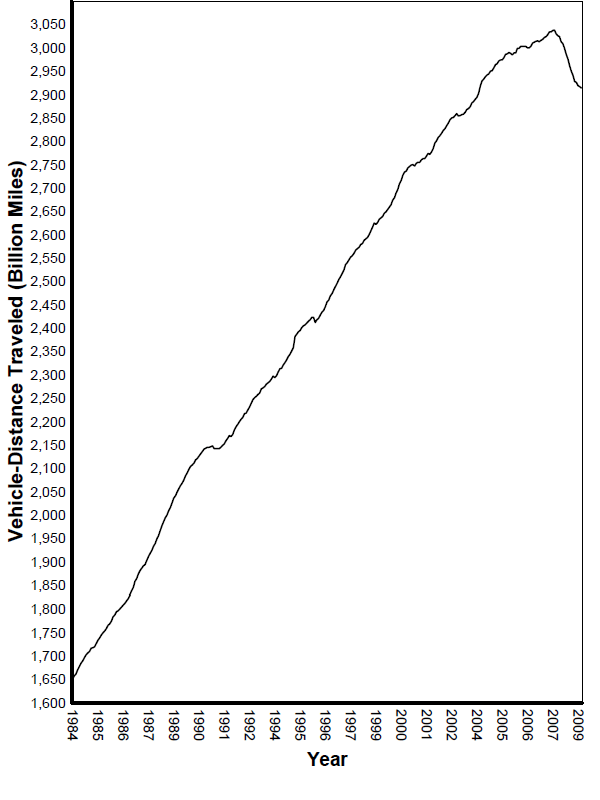
The local headlines of the past few weeks have declared that only a handful of Kentucky's dealers have received notice of their contracts ending, but have we only seen the first wave? According to the FHWA the vehicle miles driven in the US has fallen for almost a full year now, but strangely the total miles driven in Kentucky are on the rise. This may be the result of having to travel farther for employment in the more rural eastern portions of the state or the sprawling of the suburban areas of the population centers, but this will change as the price of fuel rises again. I doubt that we have seen the end of dealer closings.

In conjunction with the vehicle miles driven reduction is the loss of revenue for the Highway Trust Fund which pays for the government's portion (80%) of new highway jobs. I also feel that the balance in Congress will affect the way Kentucky will benefit in the future. The Democrats in power may try to coerce Mitch McConnell to compromise by withholding highway money and projects for our state and local jobs.

Today, I also read the American's are flying fewer miles for the thirteenth month in a row for both business and vacation travel. Here the decline is even greater than in auto miles in a year to year comparison. This may have an adverse affect on the Alltech WEG in 2010, and for that we have no contingency plans.

It may already be too late for Lexington and Kentucky to prevent some kind of transpotation gap from occuring in the near future. We have not planned for any structured mass transit(i.e. light rail, streetcars) nor have planned for greatly walkable cities and complete streets. We will also need to plan for the delivery of goods and freight by some other means than truck, if fuel prices get too high, as well as growing more foods locally.

What are you doing to close your transportation gap?

Monday, May 11, 2009

The Library's Parking Problem

This is something that I should have known.

Or something I heard/read and it just didn't register, but the parking garage under the Park Plaza Apartments is owned by the Lexington Public Library.

I know that it was built by the State and that the apartments built above are in Lexington's second platted "air lot". I watched the structure being built from an office window. Four years ago the Library bought the garage.

There is a sign above the entrance on Main St, right beside the Library building, and nothing identifying it from the Water St side. From there it appears to be the parking reserved for the apartments. I and Mrs Sweeper have both been under the impression that the majority of the spaces in the garage were taken on a regular basis.

I have seen times when the Government Center Annex was so full that people have circled until they leave and go to find another garage or a space on the street. Many would be surprised to know that they could park in the Library's garage just down the street. Parking has been thought to be at a premium in the downtown and spaces in this garage are going unfilled. Now would be a good time to advertise that this PUBLIC parking.

I of course, as all of you should know by now, think that the need for parking garages should be lessened by the inclusion of a good streetcar system and regional rail. This would also decrease the need for parking in the CentrePointe development and enhance downtown.

Wednesday, February 18, 2009

Transit Poll recap

Well the poll is closed and I was surprised at just how close the voting was.

I, of course, voted for the surface running tram. I just think that it looks cleaner. Some of the examples that I have seem, have the trams running along not only on the streets, but also through some very grassy strips beside the roadway. If the system utilized the power supply devised by Bombardier, the one that powers by inductive motors, then there would be no overhead lines to clutter up the scenery.

To those of you who voted for the elevated system, I would like to hear your reasoning if you would share them. My dislikes about this system revolve around:
  • (1) the massiveness of the poles and guideways. In our downtown, I think that this would detract from the overall look of the city. I know, the buildings downtown are mainly bland and boxy, but adding large supports and rails up to 35-40 ft in the air all through the downtown area is a bit much. The historic neighborhoods bordering downtown have restrictions on style and design, although the supports could be styled to fit in, I guess.
  • (2) The number of guided vehicles. Even the Starship Enterprise had a limited number of turbolifts. The photo shows just a few pod vehicles, which appear to carry 4-6 person each. Some other proposed systems are designed for smaller occupancies, thus would require a greater number of pods. Most systems have proposed the control of the pods to be done by computer and not by human steering. While this could be programed and work well for a simple number of pods we all know that with a rise in pods the complexity increases exponentially. I recall just how well the automated baggage system has worked at the Denver airport (that is to say it failed and ran way over budget).
  • (3) The appeal of the private auto, for most people, stems from one person exerting control over the timeliness and cleanliness of that persons vehicle. In an automated guideway system of pods, that control is limited or eliminated altogether, even if there is only one occupant at a time.
One can talk all they want about the advances in technology and the new computer systems coming on line, but the psychological makeup of of mankind has not made such strides. The Wall Street Journal had a report yesterday about some of the new "smart technologies" being investigated and how giving the driver more information allowed him to make better decisions. I see this as contrary to the programs trying to get drivers to put down their cell phones, ipods and other distractions that keep them from concentrating on the task at hand, driving. In watching my son playing his video games , with all that information on the screen, I finally asked about a certain symbol and was told "Dad, I ignore about half of that stuff, I don't know". Sixteen-year-olds don't care about it and 60 year olds can't understand it, so I guess that our best drivers will be in the 30-40 year old range.

Any way, thank you all for voting and feel free to share your reasons for your vote.

Thursday, January 29, 2009

Shelters for the Trolley Riders

On the MLK Holiday, Lextran and Art in Motion cut the ribbon on their first artistically designed bus shelter the Bottlestop, in front of the LFUCG campus on Versailles Rd.

AIM's website shows that they are planning to do more "art stops" in the near future.
East End Shelter
Newtown Pike Art Shelter
Euclid Avenue Art Shelter
The two preceding facts combined with the discussion of "branding" for the circulator trolley could lead to some serious thoughts about bus stops in the downtown area. I don't think that anyone is giving it much thought now, so I went on the trail to see if I could find just something.

The current version of the Lexington Streetscape Master Plan has very little about the bus stops in the downtown and only lists a few locations for stops to be considered. They are:
145 East Main Street across the street from the Police Station.
Main Street at Cheapside in front of the Court House.
333 W Main Street.
200 W Vine Street in front of PNC Bank.
The Streetscape Plan does call for the new bus stops to be of the art type, but other than this there is very little said. The draft Downtown Masterplan says absolutely nothing.

Once again it appears that mass transit, in the form of Lextran, is left to the mercy of the current riders and given no incentive to prepare for any new ones. Even in the context of "complete streets", where pedestrians and cyclists are well cared for, the lowly transit rider is not mentioned. Is it possible that with the restoration of the circulator trolleys, that the branding could in some way lead to an art stop in one of these proposed places?

From what I have been told, the branding will run along the lines of "The Colt". This seems simple enough, a colt is a young male horse, something that will grow up to be a mature animal someday. (maybe there is hope for a real streetcar someday.) There are some statues in Thoroughbred Park of some colts, the ones frolicking on the hill, the one of the baby near Main St. the one of Lexington near Short and the ones driving for greatness at the finish line. What this park doesn't have is an art bus stop.

If what I proposed here the other day could be built upon, this would be either the start or the finish of the entertainment loop, and what would be better than a Colt branded, art type, bus stop. As I think of it now, this could be difficult to do or it could be simple. I doubt that we could get Gwen Reardon to donate her talents to help design a stop, but something along that line is not totally out of the question. This will go a long way toward making up for the lack of public art which I posted about back in November. There are other equine artists working in bronze . Seeing as how the Triangle Foundation own the park, could we approach them for a little assistance.

What about a challenge to some of the famous horse owners to have a design for their top thoroughbred, for a series of stop progressing down Main St. (and maybe some Standardbreds along Short)?

I have shown disdain for this in the past and still believe that we as Lexington can do better, do more, for the mass transit starved people of Central Kentucky, but if I can put forth these ideas as an opponent what are the proponents putting forth? Where is our "creative class" in such an artistic endeavor?


Wednesday, January 28, 2009

Entertainment Loop Follow-up

I have had a few more thought on the subject of the downtown circulator.

If the route described in my last post(or something like it) is adopted, then the businesses that benefit from its service should have some say in how it is branded. My first thought was for the stores and restaurants along the route could distribute cards for discounted rides, much like the parking tags from the garages that we are used to. Then I remembered that there is no fare to begin with. But there must be a way to gauge the effectiveness of the trolley on the downtown businesses.

While in Whole Foods the other day I saw their "wooden nickel" campaign where they let customers donate to their favorite charity by donating a wooden nickel. Something similar could be done for the trolleys. A set of tokens could be prepared for any business which wants to participate, each entity having its identifying number, then allowing their patrons to essentially vote for the trolley by dropping their token into the farebox. The tokens are then counted and the businesses with the highest number of patrons for the month get some promotion by Lextran or some other type of benefit out of the trolley. It would also allow for ridership breakdowns and friendly challenges

The Mayor has said that he would like to see the trolley given some sort of "branding" to make it stand out in the minds of the riders, especially the tourists. It needs to be some sort of fresh idea and, I would hope, much more different than the typical "vintage" things that they had previously. I am, by nature, a history buff and enjoy perusing old photos, but if we can't do better than the last weak attempt at trying to stylize a regular streetcar, I think that we ought to stop right now.

As I have stated before I wish for a modern, steel-railed streetcar and believe that one can be placed downtown. There are now systems being developed that allow for the trams to be powered without overhead wires, using inductive coils to power the motors. These systems are currently being tested in France and Germany and appear to hold great promise.

I will leave you with these last questions.
Are the European engineers better trained than ours?
Do the Europeans and the Australians know something that we don't?
Are their cities better than ours or their history better than ours?
If they can do it , why can't we?

Monday, January 26, 2009

The Downtown Entertainment Loop

I am not a big fan of the so called downtown circulator that is being planned for Lexington, but if the powers that be are going ahead then let us make it work to the City"s advantage.

When Lextran first began to gather input for the possible "trolley route", my wife and I attended a meeting or two. I can tell you that I was not impressed with the way the survey was conducted. I can now tell you that the situation downtown has changed, some say not for the good, but it has changed.

There are now new restaurants and bars that were not open at the time, and more planned.
Devassa, Lower48, Cosi and the Chase Tap Room in the Victorian Square.
The Penguin Piano Bar in The 500's on Main.
Buster's will be relocating to Short and Broadway.
Cheapside has been closed to traffic and will be a publc gathering place.
The Court Square Building has Redmond's in the basement and a coming Skybar on the roof.
The Olive Tree has replaced Kiser's at Upper St.
Mia's moved to Short and Lime to join the long list of eateries on Limestone.
The business owners on the Esplanade have announced a renovation of that block to go along with the renovations going on in the North Mill block.
The Dame has made a successful move to E. Main beside the Main and Rose complex
There is supposed to be a CVS pharmacy replacing the Integra Bank and other buildings soon.
These combined with the existing Portofino's, Bellini's, Taste of Thai, Desha's and some other smaller places all make up a dining/entertainment district between Main St and Short St. These places do most of their business at night, so why not run the circulator along Main St. and Short St., not just at noon, but in the evening, well into the later hours of the entertainment schedules.
This seem to make more sense than an East/West run at lunch and a North/South all evening. Where is the sense in traveling along Vine St, with no place to get off from Broadway to Midland. If we are concerned about the Lexington Center businesses, there can be a figure eight around the Triangle Park to accomodate them.

If the eventual restoration of two way traffic to Main & Vine is made, the completion of CentrePointe and the additional developments that will replace the Transit Center, then another loop along Main & Vine is not out of the question.

If we can't have a real streetcar on rails, then let us do something that may just work as a stopgap measure.

Monday, January 19, 2009

Destination 2040: Part 4

Today, we will pick-up with the action statements for Physical Growth. This aspect concerns where we place the elements necessary to implement to actions for Human Needs and should be thought of in relation to the next aspect, Economic Expansion.
For Aspect 2, Physical Growth, the community elements are:

Transportation Alternatives / Monorail
Public Facilities such as Parks, Schools

Land Use Decisions

Infrastructure - Roads / Utilities

Population Growth
Infill and Redevelopment
Planned Urban Growth Areas
Green Building - Sustainability
Preservation of Natural and Built Environments
As we saw previously, the rankings are a little out of kilter. The implementation of infrastructure, public facilities and transportation alternatives is simplified by good land use decisions. To that end I will re-arrange the top four elements in my comments.

Actions suggested for Land Use Decisions begin with identifying a group of “permanent stakeholders”. Is there not a group currently identified, called the population of Lexington and Central Kentucky? The participants listed lean heavily toward the rural preservation side of any land use question, so, how does this limit the conflict in these said decisions?

The next two actions may be reversed as I see that a total review of the zoning ordinances and regulations should take place before any revisions would take place. Both of these are needed and it is probably a good time to set this in motion again. The last re-write of the ordinances was done in the late 80’s and the one done before that was mid-60’s, so every twenty years or so is not a bad average.

Our fourth action statement about Land Use is a move toward using less land for residential development, which is almost a given since maintaining the Urban Service Area boundary as a limit to growth is a treasured goal. This smaller, more vertical housing type is perfect for mixed-use and/or TOD projects.

A move away form the current restrictive system of parcel-by-parcel zoning into a more general sweeping rezoning of property may have greater legal implications and in some instances a perceived taking by some landowners. Five years may be a very short time-span in which to complete this action, considering the possible legal ramifications.

The last Land Use action entails expanding to a regional approach in all planning decisions and some respects, small baby steps have been taken. These small steps should continue until we can pick up the ball and run full force. The history of animosity between Fayette and our surrounding counties needs to be acknowledged and each party make amends to foster a useful regional planning agency.

The Transportation and Public Facilities actions should be taken in cooperation with each other, as the public facilities need to be connected by the transportation facilities. The first three transportation actions are a logical extension of the current mode of operations. More park and ride lots are a short-term solution, at least until the transit system can begin to reach within a quarter mile of the residents. The park and ride lots can evolve in to stops for the light rail/streetcar system. Light rail, in the context of this report, does not seem to be a regional system but more of a streetcar style transportation mode. The expansion of services to regional communities and the regional agreements (and not just those concerning Versailles and Winchester) should go hand in hand. The expansion should not stop at the first ring of surrounding communities, but they should help connect us into the rest of the Kentucky Triangle.

The enhancements to the regional parkway and Interstate system may be obsolete by the time they are paid for, so any return on investment should be carefully considered. Likewise the use of HOV lanes, as these solutions have had various levels of success in other locations.

How did we let the discussion of cycling and our trails system get so far down the list of actions to be taken (8 out of 9). This should be much further up the list.

The work with out state legislature, should not be about more funding (that sound like tax increases), but a re-prioritizing of the existing funding structure. The new Federal administration appears to want to start the pendulum in the other direction in terms of its funding of transportation in the latest stimulus proposal. We and the state should jump on that band wagon.

The advanced planning for predictable public infrastructure/facilities should, as noted above, be done in conjunction with the transportation elements being set forth. Facilities should not dictate where transportation linkages go, but should be planned along side the linkages. Any park/trail funding should be similar to the transportation funding and be re-prioritized from within existing funding.

The other three actions under the Public Facility Capacity list are ones which may be combined in some way. A large amphitheater and a new major civic arena may (or should) be considered together, likewise the requested brownfield redevelopment on Old Frankfort Pike have the amphitheater. In any case they all should be planned along a transit/streetcar/light rail route.

All infrastructure be it public or private should be adequately maintained. That is the reason that we have a Code Enforcement division, to keep everything up to code. We should and do allow for flexibility in the design of creative solutions, but we should not jump at any and all different designs just because they are different. We should not only promote, but require underground utilities in the urban core area. It should be required in all redevelopment of anything within a two mile radius of Main and Limestone and we should enlist the cooperation of UK in the accomplishment of this action.

The implementation of all the transportation facilities, public facilities and infrastructure utilities need to completed within the framework and predicated on the good land use decisions with we started this entry.

Friday, January 16, 2009

Destination 2040: Part 3

Today let us pick up with the actual actions identified for each of the different aspects; human needs, physical growth, economic expansion and cultural creativity. The elements which comprise each aspect make sense, but I am a bit confused as to how they arrived at their rankings. I must assume that during the civic involvement phase some sort of weighting system was used as only the top four of these community elements has an action proposed.

For Aspect 1, Human Needs, the community elements are:

Safe, Adequate, Affordable Housing
Educational Opportunity
Medical Services / Health Care
Essential Resources
Governmental Services – Citizen Safety & Welfare
Adequate Nutrition
Adequate Treated Water Supply
Spiritual Life of Community / Religious Expression

Just how an Adequate Treated Water Supply was not included in the Essential Resources baffles me, as well as why it rates below the Government Services element. There is no need for feeling safe and secure if you have no nutrition and water, medical services become more necessary without nutrition and/or water, so these elements should be rated higher.

As for the actions to be taken on Safe Housing, the first one starts out “Take action, through ongoing practices and policies,”. To me that says to keep on keeping on. Continuing to use the same policies only reaffirms the status quo, and we can see how well that has been handled. Action two wants to extend, to other areas, a program that, in Lexington, has not been tested fully. Maybe we should walk before we run. Thirdly, the action of adding to the government staff to enforce the rules upon a populace which, as we saw yesterday, will be cooperative, willing and trusting, and only trying to do what is best for the community as a whole (see value statement #1).

Action statements for element two, Educational Opportunity begin with a desire for alternate funding to support a primary public education and progresses to full support of the UK mission and the Fayette County Schools vision plan. These three individual statements do not indicate that there is any actual (or perceived) opposition to any of them and as state mandated/supported entities, these actions are currently being followed both locally and statewide. Frankly, in my opinion, I believe that any post-secondary education should be encouraged and that the costs of such should be kept affordable, but they are hardly an essential human need. It has been said “The poor, you will always have with you…” and they need a basic education, but beyond that a practical experience education will suffice.

Element three, Medical Services/Health Care, has actions such as making a commitment to healthy living and wellness plus affordable basic health care, which are laudable goals. Is this only asking to grow the health care field, which, for Lexington if not nationally, is already one of the fastest growing segments of our services sector? This starts to smack of trying to emulate a Nashville or other major medical center. The action statement to make Lexington a leader in secure electronic medical records makes me nervous and leery of a Big Brother type scenario. Even the OnStar program has its assurances of privacy, but the car thief does not push that little blue button.

One can tell that this is a government directed process when the starting actions for Essential Resources concern the LFUCG’s pre-conceived, coordinated strategic plan and as such are already in place. Mission accomplished anyone? Fresh, locally grown food is available, but the combined readily tillable acreage in Fayette and the surrounding counties could not provide an adequate nor sustaining supply. Given the idea of sustaining the entire community, one single Farmers Market location is not sufficient. As it is, there are multiple sites currently operating in temporary locations and one, central location would pose a transportation/parking nightmare. Come on people, we have better vision than that.

This next Essential Resources action may take a paragraph by itself. Make Lexington a leader in improving air quality by reducing greenhouse gases and employing sustainable choices in housing, transportation, energy, and other community activities. As part of this approach, ensure that LFUCG, LexTran, and other public sector entities continue to invest in energy efficient vehicles. On the face of it, it seems to be about air quality and the use of new technology to bring about that end. Better planning, form-based land uses, TOD (transit oriented development) and mass transit(streetcars, light rail) are all existing, low-tech strategies to be employed which will reach the same results. Larger numbers of energy efficient vehicles will not reduce the greenhouse gases, they will just relocate the sources of those gases. Lower numbers of higher capacity, efficient vehicles will affect the level of said gases significantly. As these transportation and planning efforts are completed the following action about low-income/disabled residents will solve itself.

Lastly for today, an action statement relating to connecting to the digital world. People must remain connected to important basic living systems… Folks, as much as I use the Internet and a computer, and Mrs. Sweeper says that I spend way too much time online and may have an addiction problem, life can go on without the technology that we have all become used to. Life would not be as comfortable as we may like, we would have to re-learn some of the old ways to get by and we may have to start to relate to each other in a more personal way, but life would go on. The technology of the digital world is not an essential resource.

Wednesday, January 7, 2009

Everybodys talking - Nobodys planning

In today's entry for Naked City, Mary Newsome relates that John Muth of Charlotte Area Transit System (CATS) gave a presentation to the Charlotte-Mecklenburg Planning Commission on Monday. Regardless of the content of the presentation, I find this to something worth thinking about. In my 30+ years of watching the doings of planning in Lexington, I have never, I repeat, never seen the representatives of Lextran or their predecessor approach the Lexington Planning Commission to present anything, much less a report of their thoughts on transit planning.

The Lextran board and staff seem to have an agenda and process for dealing with the growth of Lexington. From what I can see, it looks like We'll wait until it shows up and then we'll deal with it...maybe. Mass transit in terms of land use decisions is always an afterthought. The Planning Commission's process for dealing with growth looks like We'll see what they bring us and see if we can tweak it until we like it... or it is tolerable. Mass transit in terms of land use decisions is a never thought. The Urban County Council's process for dealing with growth looks like The larger our population the more Federal dollars we can justify...or at least ask for.

From the very beginning Lexington's mass transit options have been privately held corporations operating under a franchise granted by ordinance. The omnibuses, the mule drawn streetcars and the electric trolleys were all private corporations. They built the lines for the people and built some entire residential developments specifically for the streetcars to service. It is only since other private corporations lobbied for and influenced legislation to remove the streetcars that they evolved into a motor bus system. Then, as they struggled and slowly declined, did the government step in and assist in the operation of a mass transit system, and barely funded it at that. It is now assumed, nationally, that governments, local and national, are required to operate any mass transit system and many do, so as to assist the poor and under privileged in reaching jobs and remaining employed.

There have been several commenters on Mary's blog who are blatantly anti-transit, as expected, and they echo the many other anti-transit folk nationwide. Most of them call for a transit system to be self sufficient and pay for itself by fares. This, of course, is countered with the claim that drivers should pay for the roads and those who call the police should pay for that service. This of course cannot work, but under that scenario, I would pay for the construction(but not the maintenance) of the sections of the arterials that I drive to work each day. As there has been no construction on any of the roads I travel on my 7.5 mile daily round trip, in the last 40 years, what do I owe and to whom?

Some say that the gas tax pays for the roads, well, yes and no. The gas tax does go to fund the Federal Highway Fund, but I can use local streets that were built by private developers as far back as the 1920's and are maintained by the local general fund, without a cent of Federal money. So, what I pay in gas tax goes to pay for your benefit? In reality, the roads built in the urban areas is paid for by the more rural counties, so how is that fair?

This argument also shows up on the Overhead Wire, in his entry about Salt Lake City . Here we find the regional planners wanting to go with a reversible lane setup and HOV lanes, and the local council wants a light rail system. A couple of legislators want to plan for the future demand and not for the current ridership. My question is; Would the Interstate highway system have been implemented nationwide based on the demand of the 1940's (without the military influence, of course). I'm glad to see that some city councils wish to direct the growth and type of growth in their jurisdictions.

Lexington can say that they want mass transit and then do everything possible to make it easy to avoid using said system, or they can build the system and then do everything possible to encourage the people to use it. These would include, but not be limited to:
  • Reducing parking
  • Eliminate extra lanes
  • Increase vehicle fees
  • Congestion pricing
  • Implement land use decisions dependent on transit
For that last one all the parties involved would have to get together and get on the same page. Now I know that the Council and the Planning Commission will hold a joint session soon, but the Lextran board is still missing from the mix.

Monday, January 5, 2009

Streetcars for redevelopment

Several things have come to mind in the past few days.

First, the thought that a streetcar/light rail system could help pull Lexington and the rest of the nation out of the economic quagmire in which we find ourselves. Surely not, you say.

No. Not by itself. Not as a single effort. But as an essential cog of a larger effort, yes I think it can. It can not be a limited system serving a small section of downtown, but as a city-wide system reaching all the far-flung sections of population and destinations. It should be centered on the downtown, but not as a cross-hair or central station concept, but as an encircler of the business core. Think of the Ringstrasse and substitute the streetcar for the driving lanes. These would circle downtown about one or two blocks off Main and Vine Sts. That would mean Second or Third on the north, High or Maxwell on the south, the new Newtown extension on the west and a combination of Ashland, Walton or Midland etc. on the east.

Two streetcars, one running clockwise and the other running counter-clockwise would circle the downtown on a regular basis. Now, add to this a series of outward circles of routes. For example, a route running out Richmond Rd to New Circle Rd., around New Circle to Liberty and back in to Winchester Rd/Third St. and in to join the ring around town until reaching Main/Richmond and heading out again. Other similar ring routes would progress around the city, the outbound leg using the previous routes inbound leg, providing two way traffic on all inbound/outbound legs of all routes. Ideally no one should be more than three blocks or so from a streetcar line. Another set of ring routes would continue outside of New Circle Rd, at reasonable distances, until the urban area is covered. Some south-side areas may need to have a series of smaller ring or figure eight loops arranged in order to fully cover the residential areas.

This would be no small feat to accomplish and would need the backing of the Federal government, but if we subsidized transit the way we do roadways it is do-able. President-elect Obama has indicated that his administration will encourage and fund more mass transit projects.

Secondly, with systems similar to this in other cities and states, the steel industry, which has seen orders fall sharply lately, would be called on to supply the rails and rolled steel for car bodies and wheel sets. The auto makers by retooling to produce streetcars could be inundated with orders. The power companies would have to upgrade the entire statewide power grid in order to supply the electricity. New pylons and towers with wires and cables again helping the steel industry. More power generating capacity and distribution will require more design and production personnel. We have one of the premier rail service companies in the US in our own backyard, right down Nicholasville Rd, in the R.J. Corman Co. All of this means jobs.

Thirdly, and last, where two or more of these ring routes meet, there is the possibility of transit related development (TOD) . Some of these sites are already in decline or dead (i.e. Lexington Mall, Turfland Mall). Retail redevelopment of a mall site would not normally constitute a TOD, but adding some New Urbanist elements or large amounts of residential and deleting the auto centric design features similar to this Natick Mass. mall could revitalize some of our recognized underutilized property.

As big as this proposal sounds, it is just a first blush glance at how Lexington and a streetcar system could help lead an economic stimulus for the whole nation. Does anyone want to help flesh this thing out? Help push this to the powers that be?

Give me some feed back.