Showing posts with label light rail. Show all posts

Monday, October 8, 2012

93% Say A Plan Does Not Exist

Did you know that there is a company with a specialty in infrastructure strategy and product development on a global scale? No, they are not located in Lexington nor are they planning to move here, but the fact that they exist encourages me. That means that someone is looking out for the built environment of the facilities that connect us or enable us to connect with others.

CG/LA Infrastructure, Inc., which has been around for 25 years and is considered by some to be an industry leader, has just released their latest survey on infrastructure priorities in America. The survey questions were asked of high level executives from all regions and disciplines of the building industry. So, were their conclusions surprising to most folks? Maybe not.

93% believe that the US has no overall infrastructure plan. Wow, that is not news to just about everybody.

Why is it that when we have such huge systems as the Interstate Highways, the national power grid, massive pipeline connections for both oil and natural gas, multi-state water supply lines for our larger cities and even our renewed and growing freight rail network, there is NO overall plan to coordinate them? Do the systems not compliment each other as a whole?

Without a plan there seems to be “…potential for disaster at every turn." as one executive put it. As we have seen in California in the last few weeks, just a small number of minor inconveniences to the petroleum refining system have caused huge headaches for motorists of that state and for many others. A small “glitch” in one system can be magnified through the interdependence of other systems.

57% of respondents encourage public-private partnerships as an important action which can be taken to solve our present situation. 47% favor increasing the gas tax, which has not increased since 1993 and now buys about half of what it did then in infrastructure improvements. (Very politically unpopular) 44% mention the creation of a national infrastructure bank which in this political landscape of gridlock, both in Washington and around the country, may be extremely difficult to do.

In terms of highest or above-average priority for infrastructure investment, it should surprise no one that 79% list our nation’s bridges as needing repair. There is a growing list of sub-standard bridges right here in Fayette County and Central Kentucky. Transportation for America has a map which shows some of the worst. Water and waste-water systems are also high on this list. Our own experience with the EPA Consent Decree stands in the bright spotlight as evidence of this national need. We are not alone in neglecting things which we cannot see yet rely upon so much on a daily basis.

Two-thirds of the respondents mentioned highways as needing more funding, and perhaps they do, but we are already spending massive amounts on soon to be out-dated or obsolete highway projects. If we were to limit our thinking to just this element, could it be that in our desires for high gas mileage and the thrill of driving the open road has left us with clogged roadways and no way of funding improvements? I wonder if those who are able to afford the high mileage auto and live the furthest form their work are the same ones demanding more and better highways.

And how do you think that they felt as to the satisfaction with federal government's role in infrastructure development? 93.5% think that federal government's handling of infrastructure is a job which needs improvement (an understatement?) or just plain poor (abysmal may be a better assessment). Just what is it that we want the federal government to do? Is it government’s job to identify the shortcomings in infrastructure and repair them or should they guide the planning phase of facilities repair? Either way this seems to smack of “big brother” control or influence which our fiercely independent residents would balk at when it comes time to pay the tab. I can hear some of my friends now crying out that private industry can do it cheaper and better than government and yet private industry does not do it because the return on investment is not there.

Shorter approval processes and enabling legislation to allow private sector investment were cited as actions which could be taken to aid the necessary repairs and expansion work. I could assume that faster approval times will indicate a much more lax regulatory environment in which the private sector may reap higher profits yet result in a familiar product. The electric grid and the oil/gas pipelines which need the repair are presently in private hands, are they not. Many of them do not have the best track records in safety and environmental concerns, which may be the way that we got into this shape in the first place.

Government, and especially the Federal government, cannot be solely blamed for the pipeline leaks or the refinery fires and outages. The rail industry, despite its governmental regulations, is again growing and expanding, in major part with private dollars and an improving safety record. The electric grid, as robust as it may seem, is still a delicate lacework which is very much vulnerable to the whims of nature and the evil intentions of terrorists both foreign and domestic.

Remember still that this survey was of the high level executives who are concerned with major elements of life as they know it. What about the portion of citizens who are less than privileged and barely above the government's guidelines of poverty or those who are directly in poverty. What infrastructure is required for them to live a better life and how much do these “high level”executives concern themselves with the systems designed strictly for them?

There was a passing reference to multi-modal systems as associated with freight rail, but no mention of public transportation either locally, regionally or nationally. Should there be a 'potential disaster at any turn' as we have seen predicted above, what back-up (or possibly redundant) system will be available to aid in restoring normalcy? The disruption of oil/gas flow can upset just about all of the Interstate travel and the airlines could not mobilize enough to compensate and travel by rail would be non-existent even though it is the most efficient of the three. The destruction of a few major air control centers will hobble the airline industry, more-so internationally than cross-country, with resultant slowdowns of service.

On the local level, a robust public transportation system would save more than enough fuel to weather an extended slow down. Regional rail systems could suffice for the lack of highway and truck capacity for some freight deliveries. Regional and local farming should sustain the populace until new systems can be put in place. An ultra reliable water supply will prove extremely valuable.

93% of the survey respondents believe that the US has no overall infrastructure plan. I know that we have no real local plan. We have a response plan which may work for he short term, but a plan to rebuild our systems should something happen disastrously or they wear out incrementally, I do not believe exists.

I do believe that one should be developed.

Wednesday, December 16, 2009

Look Local, But Not Too Local

I guess this goes to show that you just can"t find everything locally. A friend alerted me to this tidbit of information.
Rep. Ben Chandler, D-6th District, designated $2.5 million for foreign language programs in the Fayette County schools.

He also got $500,000 for the construction of a trail system in the Lexington area; $334,000 for the construction of a facility in Frankfort that will centralize all administrative services of the Kentucky National Guard; $325,000 for a domestic violence program in Lexington; and $300,000 for a study of mass transit alternatives in Central Kentucky, including light rail.
It comes from the Louisville Courier-Journal and was posted sometime Sunday evening after the final Senate vote. It was buried, way down at the bottom, but I would expect that from the Louisville paper. I cannot find it anywhere on the Lexington Herald Leader site nor do I remember seeing it in print. Not in print anywhere in Lexington.

Our 6th District Congressman, Ben Chandler has come through for us again in this funding bill.
  • $2.5 million for the foreign language programs in Lexington.
This is good. I can support this, and not just because my guys went through the Spanish program at Maxwell. I think that we are going to need to understand our foreign visitors while we still have them. It may also help with some of our more recent additions.
  • $.5 million to build a trail system
Not just any trail system, a multi-use system for walkers and cyclists. A system that connects our neighborhoods to the parks and schools nearby. If we can't get our developers to make the connections, then I'm glad that the Federal Government will help.
  • $.3+ million for a building to house the administrative services of the Kentucky National Guard.
We need to help out the guys in uniform if we are going to use them so much. GO GUARD.
  • $.3 million for a domestic violence program.
This is a violence PREVENTION program I am sure. We really don't need any more violence than we currently have.

Then, here we go, right here at the bottom. One of my passions(you know this if you have read me any time at all) is some money for transit.
  • $300,000 for the study of Central Kentucky mass transit. INCLUDING LIGHT RAIL
Right off the bat, I am not sure that $300,000 would do that much of a study. Then I wonder, who is going to do the study? Lextran? Oh I hope not, they don't cover enough of Central Kentucky. The MPO? I don't think so, I have not seen that much interest in regional transit or light rail from them. Bluegrass ADD? Tell me that is not right. We might as well give the money back for the kind of study that we would receive there.

Can we get Rep.Chandler, Gov. Brashear and Dr Dan Mongiardo together and make sure that this get done right? And maybe we can get a little press about it this time.

Tuesday, September 1, 2009

Failing To Build Is Building To Fail

We in America are poised, again, to fail.

The opportunity is rearing its head and I wonder if we can jump at the chance to show our collective stupidity, again. The current rage in Washington, if not in parts of the rest of the country, is the stimulus money designated for High Speed Rail(HSR). $ 8 Billion for HSR and that is promised to be the starting level. Even more stimulus money is planned for rebuilding our other rail facilities. Yet nobody is talking about revamping our automobile industry to include the HSR vehicles. And somebody else is watching.

German engineering giant Siemens and their national railway operator Deutsche Bahn, already well ahead of America's companies, are hungrily watching to see how much they can profit from our stimulus package. Will our tax money pay for returning their workers to full employment? Both GM and Chrysler are being bailed out by the US taxpayers yet the only transportation modes being considered for these companies is automobiles and trucks. Where is the evidence of American ingenuity and expertise in the rail industry, why firmly planted in the dismantling of the passenger rail system back in the '60s.

This past month the "Cash for Clunkers" program boosted auto sales for Ford, Toyota and Honda yet did little for GM and Chrysler (see link here). And just who are the majority owners of these fine losers? The American people, of course. We need to pay ourselves first and invest in an American controlled transportation manufacturer. That will take a change in just what we manufacture.

We are going to need a quantity of light-rail vehicles, as well as a larger quantity of heavier rail vehicles and a good number of High Speed Rail trainsets. I see no reason that these vehicles cannot be produced right here in the good old USA. By the folks that built the trains that connected the East coast with the West. We can employ our own engineers to design our rail facilities(NASA probably has a few dozen capable of the job). We have people who can design and build the tracks, as well as maintain them, right in our back yard. So, how long are we going to stand in our own way of getting the job done?

There is currently only ONE producer of streetcars in America, The Oregon Iron Works, and they aren't even in the transportation business. They do dams and bridges and things. Shouldn't we have our transportation people designing these things?

The "Cash for Clunkers" program was to designed to make the individual auto more efficient, a streetcar system can make our entire city more efficient and a High Speed Rail system can make the whole country more efficient.

One last question. Does anyone know the total value of the aircraft owned by the aviation industry, both in service and those mothballed out in the desert? I would love to know the answer.

Wednesday, August 19, 2009

Are You Paying For Someone Else's Airport?

I learn something new every day but today's new facts are startling. The Federal government pays(subsidizes) airlines to fly to many smaller airfields that cannot support regular air traffic. And this is how the "free enterprise" system is supposed to work?

This whole subject came up from a link on Overhead Wire to a story in the New York Times on small cities helping to pay for their air service. There was mention of a program that I did not know existed, the Essential Air Service program. This program was put in place during the deregulation of the airlines in 1978, so that smaller communities which had air service would not lose it due to corporate decisions.

The original program was set up to last 10 years, more than enough time to plan for and fund some alternatives to air travel for these smaller cities. The program has been extended and modified over the years with some airports being removed from the list of subsidized fields and, remarkably, others added to the list. The airport in Owensboro, Ky. was added sometime around 2000, perhaps due to the efforts of 2 Republican senators and a Republican congressman, and is subsidized to the tune of approximately $1.5 million a year. Recently, a new airport was opened in Somerset, Ky., another Republican stronghold, but it has not made the list -yet.

The timing of this program, coming just 10 years after the creation of AMTRAK(or the dismantling of America's passenger rail service) leads me to wonder-just where is the Essential Rail Service program for those cities who lost passenger rail service? And what about those cities who lost ALL rail service because of a heavily subsidized highway system given to the trucking industry?

Forty years of disproportional funding of transportation infrastructure leaning more toward highways than rail(or air) has left us well behind the rest of the world in terms of a balanced transportation system. Thirty years of funding airlines serving sparsely populated regions could have been spent on implementing a High Speed Rail ground work(like the Europeans and the Japanese) to the point the we too could be knocking on the door of 300 mph train travel.

The NY Times article focused on the smaller cities which don't appear on the EAS list, yet are seeing a loss of air service and the local community's efforts to maintain air services. These cities are too large for government subsidy and too small for economic air travel. They would be perfect for a regional rail connection to the HSR system currently proposed. The Europeans do it all the time, why can't we.

How many of these small communities will have the Federal government foot the bill for an airport and enough funding to get things started, priming the pump as it were, and then expect the same or increased funding to tide them over the rough spots. And how many rough spots will there be in the future? Airlines are the least efficient of all the mass transportation systems available today and I wonder how much longer they will be around.

With a new transportation bill pending(and maybe held up for a while) in Congress maybe now is the time to reconsider legislation of Essential Air Services and just how essential some of it is. Should these communities be weaned off the Federal dole and let their airports fend for themselves, a la the route that the Bush administration wished to do to AMTRAK? Should these airports let the free market decide(without outside manipulations) and if they aren't used adequately then they should fold? That is the Republican, is it not?

Monday, June 15, 2009

A Transportation Gap?

We have all read the stories about the recent implosion of the American auto industry and the notices that were sent out to the various auto dealerships across the country. Between GM and Chrysler the total come to over 3,000. Who among us did not see this coming?

The competition between brand and models lately has become more of a difference of rebates and financing than quality and function. The autos offered provided less mechanical innovation and more size and flash and the dealers convinced the buyers that that was what they wanted. Very much the way that home builders built only a few basic styles and told everyone that they were the ones that were selling. Even when the hybrid autos (and highly efficient houses) appeared there were so few and they cost a premium price that the sales numbers could not match to usual models. Thanks to those who held out and waited for them (and higher fuel prices) the offerings of the automakers (and homebuilders) are beginning to change.

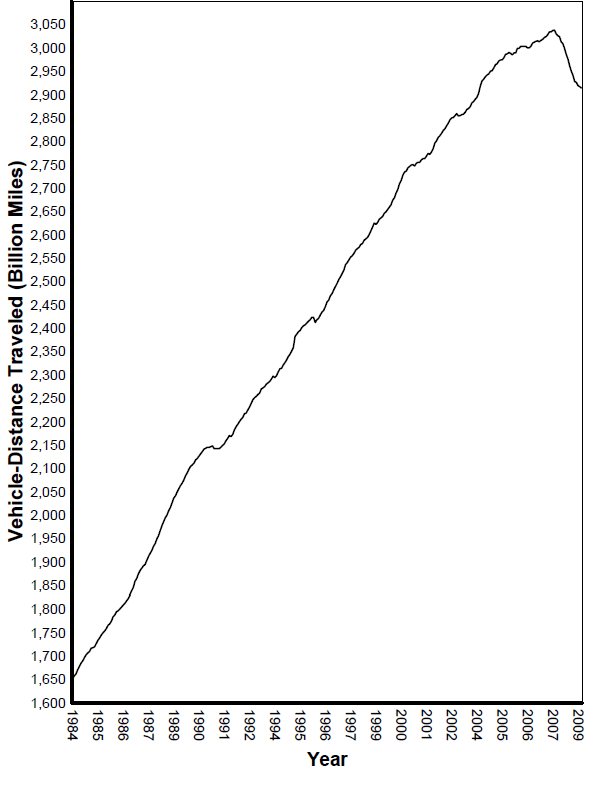
The local headlines of the past few weeks have declared that only a handful of Kentucky's dealers have received notice of their contracts ending, but have we only seen the first wave? According to the FHWA the vehicle miles driven in the US has fallen for almost a full year now, but strangely the total miles driven in Kentucky are on the rise. This may be the result of having to travel farther for employment in the more rural eastern portions of the state or the sprawling of the suburban areas of the population centers, but this will change as the price of fuel rises again. I doubt that we have seen the end of dealer closings.

In conjunction with the vehicle miles driven reduction is the loss of revenue for the Highway Trust Fund which pays for the government's portion (80%) of new highway jobs. I also feel that the balance in Congress will affect the way Kentucky will benefit in the future. The Democrats in power may try to coerce Mitch McConnell to compromise by withholding highway money and projects for our state and local jobs.

Today, I also read the American's are flying fewer miles for the thirteenth month in a row for both business and vacation travel. Here the decline is even greater than in auto miles in a year to year comparison. This may have an adverse affect on the Alltech WEG in 2010, and for that we have no contingency plans.

It may already be too late for Lexington and Kentucky to prevent some kind of transpotation gap from occuring in the near future. We have not planned for any structured mass transit(i.e. light rail, streetcars) nor have planned for greatly walkable cities and complete streets. We will also need to plan for the delivery of goods and freight by some other means than truck, if fuel prices get too high, as well as growing more foods locally.

What are you doing to close your transportation gap?

Tuesday, June 2, 2009

Some Follow-up on the 2035 Plan

In my haste last night I forgot to look at the previous 2030 Plan for what it said on the subject of passenger rail.

Well, there it was, on page 28 of Chapter 3 under the topic of RAILROADS. the section on passenger rail is an exact duplicate. Or should I say that all they did was cut and paste from the old plan into the new, without changing(or apparently checking) anything. Even with that, the study for the 2030 Plan would have been done in 2004 when the Kentucky Cardinal service from Louisville had already been discontinued.

What really grabs for your attention is the next section which is a discussion of Light Rail. This is another of my great passions. Here is some of what they wrote:
...Light Rail is and has been area of interest for the Lexington Area MPO for many years.

...This started the MPO Staff to begin light rail research and to work light rail visioning into the Lexington Area MPO transportation planning process.

... While currently economically unfeasible, this plan and subsequent plans should continue to investigate/examine the potential role and the feasibility of light rail in the future transportation system of the Lexington Area.
Now here we are five years later, and not only is there no further planning for Light Rail, but even the topic has been stricken from the document. With three of our surrounding, major cities clamoring for light rail and the rest of the nation beginning to develop and install such light rail, Lexington's commitment, so prevalent in the last plan, has vanished.

If only there was some investigative group dedicated to getting the information to the people, but I guess they have all been laid off over budget cuts or some such nonsense.