Did you know that there
is a company with a specialty in infrastructure strategy and product
development on a global scale? No, they are not located in Lexington
nor are they planning to move here, but the fact that they exist
encourages me. That means that someone is looking out for the built
environment of the facilities that connect us or enable us to connect
with others.
CG/LA Infrastructure,
Inc., which has been around for 25 years and is considered by
some to be an industry leader, has just released their latest survey
on infrastructure priorities in America. The survey questions were
asked of high level executives from all regions and disciplines of
the building industry. So, were their conclusions surprising to most
folks? Maybe not.
93% believe that the US
has no overall infrastructure plan. Wow, that is not news to just
about everybody.
Why is it that when we
have such huge systems as the Interstate Highways, the national power
grid, massive pipeline connections for both oil and natural gas,
multi-state water supply lines for our larger cities and even our
renewed and growing freight rail network, there is NO overall plan to
coordinate them? Do the systems not compliment each other as a
whole?
Without a plan there
seems to be “…potential for disaster at every turn." as one
executive put it. As we have seen in California in the last few
weeks, just a small number of minor inconveniences to the petroleum
refining system have caused huge headaches for motorists of that
state and for many others. A small “glitch” in one system can be
magnified through the interdependence of other systems.
57% of respondents
encourage public-private partnerships as an important action which
can be taken to solve our present situation. 47% favor increasing
the gas tax, which has not increased since 1993 and now buys about
half of what it did then in infrastructure improvements. (Very
politically unpopular) 44% mention the creation of a national
infrastructure bank which in this political landscape of gridlock,
both in Washington and around the country, may be extremely difficult
to do.
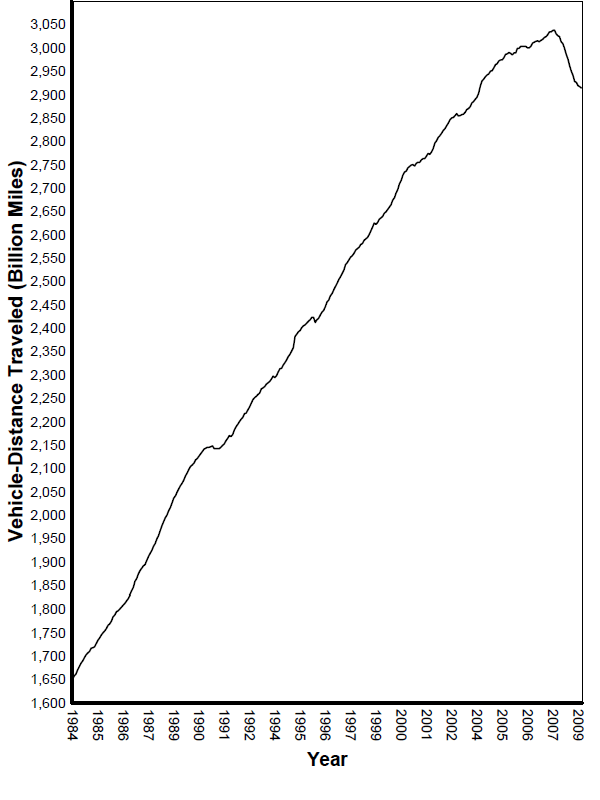
In terms of highest or
above-average priority for infrastructure investment, it should
surprise no one that 79% list our nation’s bridges as needing
repair. There is a growing list of sub-standard bridges right here
in Fayette County and Central Kentucky. Transportation for America
has a map which shows some of the worst. Water and waste-water
systems are also high on this list. Our own experience with the EPA
Consent Decree stands in the bright spotlight as evidence of this
national need. We are not alone in neglecting things which we cannot
see yet rely upon so much on a daily basis.
Two-thirds of the
respondents mentioned highways as needing more funding, and perhaps
they do, but we are already spending massive amounts on soon to be
out-dated or obsolete highway projects. If we were to limit our
thinking to just this element, could it be that in our desires for
high gas mileage and the thrill of driving the open road has left us
with clogged roadways and no way of funding improvements? I wonder
if those who are able to afford the high mileage auto and live the
furthest form their work are the same ones demanding more and better
highways.
And how do you think that
they felt as to the satisfaction with federal government's role in
infrastructure development? 93.5% think that federal government's
handling of infrastructure is a job which needs improvement (an
understatement?) or just plain poor (abysmal may be a better
assessment). Just what is it that we want the federal government to
do? Is it government’s job to identify the shortcomings in
infrastructure and repair them or should they guide the planning
phase of facilities repair? Either way this seems to smack of “big
brother” control or influence which our fiercely independent
residents would balk at when it comes time to pay the tab. I can
hear some of my friends now crying out that private industry can do
it cheaper and better than government and yet private industry does
not do it because the return on investment is not there.
Shorter approval
processes and enabling legislation to allow private sector investment
were cited as actions which could be taken to aid the necessary
repairs and expansion work. I could assume that faster approval
times will indicate a much more lax regulatory environment in which
the private sector may reap higher profits yet result in a familiar
product. The electric grid and the oil/gas pipelines which need the
repair are presently in private hands, are they not. Many of them do
not have the best track records in safety and environmental concerns,
which may be the way that we got into this shape in the first place.
Government, and
especially the Federal government, cannot be solely blamed for the
pipeline leaks or the refinery fires and outages. The rail industry,
despite its governmental regulations, is again growing and expanding,
in major part with private dollars and an improving safety record.
The electric grid, as robust as it may seem, is still a delicate
lacework which is very much vulnerable to the whims of nature and the
evil intentions of terrorists both foreign and domestic.
Remember still that this
survey was of the high level executives who are concerned with major
elements of life as they know it. What about the portion of citizens
who are less than privileged and barely above the government's
guidelines of poverty or those who are directly in poverty. What
infrastructure is required for them to live a better life and how
much do these “high level”executives concern themselves with the
systems designed strictly for them?
There was a passing
reference to multi-modal systems as associated with freight rail, but
no mention of public transportation either locally, regionally or
nationally. Should there be a 'potential disaster at any turn' as we
have seen predicted above, what back-up (or possibly redundant)
system will be available to aid in restoring normalcy? The
disruption of oil/gas flow can upset just about all of the Interstate
travel and the airlines could not mobilize enough to compensate and
travel by rail would be non-existent even though it is the most
efficient of the three. The destruction of a few major air control
centers will hobble the airline industry, more-so internationally
than cross-country, with resultant slowdowns of service.
On the local level, a
robust public transportation system would save more than enough fuel
to weather an extended slow down. Regional rail systems could suffice
for the lack of highway and truck capacity for some freight
deliveries. Regional and local farming should sustain the populace
until new systems can be put in place. An ultra reliable water
supply will prove extremely valuable.
93% of the survey
respondents believe that the US has no overall infrastructure plan.
I know that we have no real local plan. We have a response plan
which may work for he short term, but a plan to rebuild our systems
should something happen disastrously or they wear out incrementally,
I do not believe exists.
I do believe that one
should be developed.